
Idaho ADU Law Changes: What Homeowners in Coeur d’Alene, Post Falls, and Across Idaho Need to Know
Idaho’s new ADU law is one of the most significant housing law changes in the state in years, and it directly affects homeowners in Coeur d’Alene, Post Falls, Boise, and every other Idaho city with a population over 10,000. If you have heard that the rules around accessory dwelling units changed but are not sure what that actually means for your property, this guide will walk you through exactly what happened, why it matters, and what you can realistically do with your land.
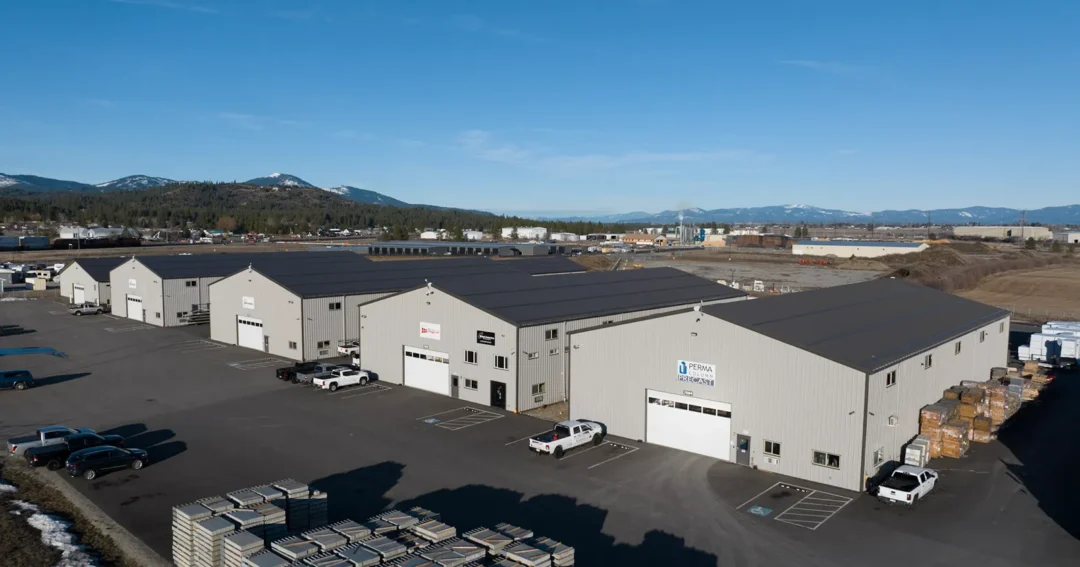
At Steel Structures America, we are based in Post Falls and have completed more than 15,000 building projects across Idaho, eastern Washington, Oregon, Colorado, and Montana. These ADU law changes matter to us because they directly expand what our Idaho customers can build. We want to make sure you have accurate information.
This article focuses on facts and clarity. If you’d like some perspective on why this is a golden opportunity, read this opinion piece.
| Important Note: This article explains Idaho state law in plain language. It is not legal advice. For guidance specific to your property and situation, consult your local planning department and a qualified real estate attorney. |
What Is an ADU, and Why Does This Law Matter?
An accessory dwelling unit, or ADU, is a second living space on a residential property. It can be an apartment inside your existing home, a converted garage, or a separate structure in your backyard. You might have heard these called granny flats, in-law suites, backyard cottages, or guest houses.
For years, many Idaho cities had zoning rules that effectively banned detached ADUs, required the property owner to live on-site, or imposed fees and restrictions that made building one impractical. Idaho’s new law, Senate Bill 1354, changes that by taking those tools away from cities and establishing a baseline right for property owners to build an ADU.
The Two Idaho ADU Laws You Should Know
House Bill 166 (2023): Limited HOA Relief for Internal ADUs
Before SB 1354, Idaho passed HB 166 in 2023. It is worth knowing about because many online sources misrepresent what it actually does.
| Accuracy Note: Many online sources overstate what HB 166 does. The Idaho Senate stripped the city and county preemption language from the bill before passage. As enacted, HB 166 does NOT prevent cities or counties from banning ADUs through zoning ordinances. It only addresses HOA restrictions on internal ADUs. |
What HB 166 actually does:
- Prevents HOAs from enforcing covenants that strictly prohibit internal accessory dwelling units on owner-occupied properties
- Prohibits creation of new restrictive covenants after July 1, 2023, that ban internal ADUs
- Protects one internal ADU per homestead only
- Applies only to internal ADUs: units located within the primary dwelling or its attached or detached garage
What HB 166 does NOT do:
- Does not prevent cities or counties from banning ADUs through zoning ordinances
- Does not apply to detached ADUs that are separate structures
- Does not eliminate owner-occupancy requirements at the local government level
In short, HB 166 was a modest step. It helped homeowners deal with HOA restrictions on internal ADUs, but it left cities free to ban detached ADUs through zoning. It also required owner-occupancy for internal ADUs. That is what SB 1354 changes: the new law eliminates owner-occupancy requirements at the city level entirely.
Senate Bill 1354 (2026): The New City ADU Mandate
SB 1354 was signed by Governor Brad Little on March 31, 2026, and takes effect July 1, 2026. It is codified at Idaho Code Section 67-6541. The bill passed the Senate 25 to 10 and the House 47 to 23. Both primary sponsors, Sen. Ben Toews and Rep. Jordan Redman, are from Coeur d’Alene, which is SSA’s home market area.
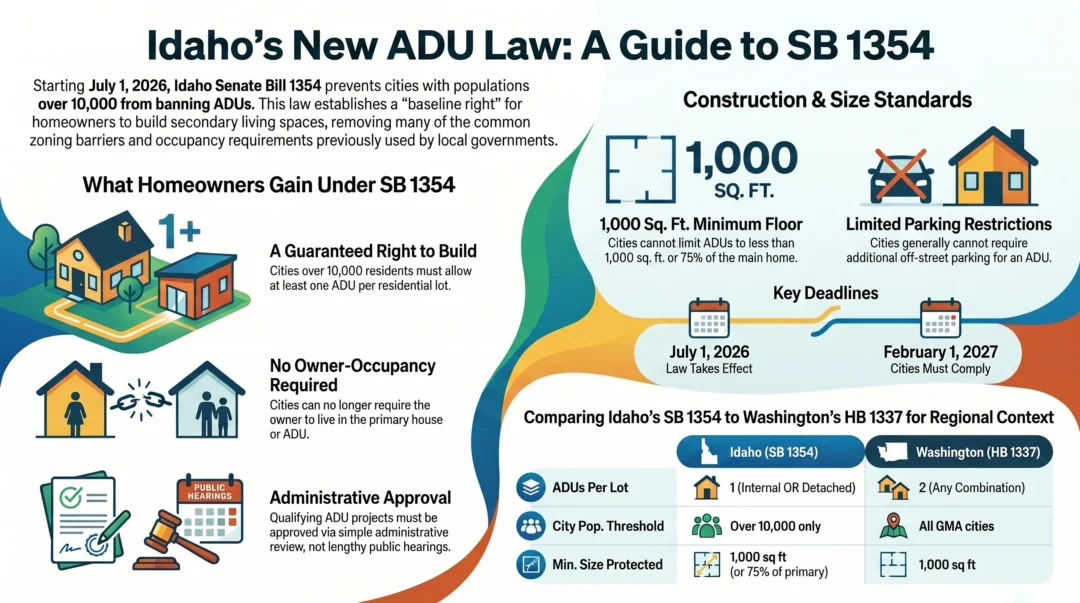
This is the law that fundamentally reshapes what Idaho cities can and cannot do when it comes to ADUs. Once it takes effect, cities with populations over 10,000 must allow at least one ADU per single-family residential lot and cannot use zoning to block them outright.
| Important: Not Yet in Effect SB 1354 takes effect July 1, 2026. Cities have until February 1, 2027 to update their local codes. The law is signed and the timeline is set, but it is not yet operative as of the date of this article. Plan accordingly and verify current local rules with your city’s planning department before proceeding. |
Who Does SB 1354 Apply To?
The Population Threshold: Cities Over 10,000 Only
SB 1354 applies only to Idaho cities with a population greater than 10,000. This is written directly into Section 67-6541(6) of the law. Cities under that threshold are not covered.
| Watch Out for Inaccurate Sources: Earlier draft versions of SB 1354 used a 5,000 population threshold. That number was amended to 10,000 before the bill passed. Some articles and websites still cite 5,000. The correct threshold in the final enacted law is 10,000. |
Idaho cities above 10,000 people where SB 1354 applies include Coeur d’Alene, Post Falls, Boise, Nampa, Meridian, Idaho Falls, Pocatello, Twin Falls, Caldwell, and several others. If you live inside city limits in any of these communities, this law will apply to your property once it takes effect.
Cities vs. Counties: Rural Idaho Is Not Covered
SB 1354 targets cities. County jurisdiction over unincorporated rural areas is not covered by this law. If you own property outside city limits in rural Idaho, SB 1354 does not give you a protected right to build an ADU. Your options there depend entirely on your county’s existing rules.
This is one of the most important distinctions to understand. If your property has a Post Falls or Coeur d’Alene mailing address but is actually in unincorporated Kootenai County outside city limits, the law may not apply to you. Check with Kootenai County Planning and Zoning to confirm your situation.
What SB 1354 Actually Requires
One ADU Per Lot: Either Internal or Detached
Under SB 1354, cities must allow one ADU per single-family residential lot. That ADU can be either an internal unit within the primary dwelling, or one detached unit in the rear yard. The law protects one or the other, not both.
| Idaho vs. Washington on ADU Count: This is one of the most important differences between the two states. Washington’s HB 1337 protects two ADUs per lot in any combination. Idaho’s SB 1354 protects one ADU per lot, and it is either an internal ADU or a detached ADU, not both as a protected right. |
What Cities Cannot Do Under SB 1354
- Enact or enforce any ordinance, rule, or policy that bans ADUs in any residential zoning area
- Require off-street or guest parking for ADUs, with limited exceptions (see parking section below)
- Charge impact fees or utility connection fees greater than fees imposed on other single-family dwellings
- Limit ADU size to less than 1,000 square feet or 75% of the primary dwelling’s size, whichever is larger
- Require the owner to occupy the primary dwelling or the ADU
- Set building height limits for ADUs lower than the height of the existing primary dwelling on the lot
- Impose setback, lot size, coverage, or building frontage restrictions more restrictive than those for single-family dwellings in the same zone
- Require discretionary approval for ADU projects that meet established land use requirements; ADUs must be approved administratively, as a matter of right
- Apply approval standards that cumulatively discourage ADU development through unreasonable cost or delay
ADU Size Under SB 1354
The size protection in Idaho’s law is more generous than Washington’s in one respect. Cities cannot limit ADU size to less than 1,000 square feet or 75% of the primary dwelling’s size, whichever of those two figures is larger. On a property with a 2,000 square foot home, for example, a city could not require an ADU smaller than 1,500 square feet (75% of 2,000). The law sets a floor, not a ceiling.
Setbacks Under SB 1354
No specific setback distance is written into the law. Instead, Section 67-6541(2)(g) requires that setback rules for ADUs be no more restrictive than setback rules for single-family dwellings in the same zoning district. The law creates parity, not a specific number. Local setback requirements for rights-of-way and easements are preserved under Section 67-6541(7)(d).
One placement requirement is written into the law itself: the detached ADU must be located in the rear yard, or at minimum be subject to the same setbacks as the primary dwelling. This means a protected detached ADU cannot simply be placed anywhere on the lot. Your city cannot impose stricter setbacks than it applies to a house in your zone, but the rear-yard positioning is part of the statutory framework.
What this means practically: you will need to check your city’s setback rules for single-family homes. Whatever applies to a house in your zone applies to your ADU as well. Your city cannot invent stricter setbacks just because the structure is an ADU.
Parking Under SB 1354
Cities generally cannot require off-street or guest parking for ADUs. However, there are three exceptions where cities may still require parking:
- The principal dwelling has no off-street parking of its own
- The street fronting the property is unpaved and not designed for on-street parking
- The principal dwelling is within one-quarter mile of a transit stop, an employment area, or commercial services
For most residential properties in Idaho cities, particularly in north Idaho, the transit proximity exception is unlikely to apply. The most important exception for typical homeowners is the first one: if your primary home has no off-street parking of its own, the city may still require parking for the ADU. If your home already has off-street parking, however, the city generally cannot require additional parking spaces for the ADU.
City Compliance Deadline
Cities have until February 1, 2027, to amend their comprehensive plans and land use regulations to comply with SB 1354. This is the deadline written into the law itself. Earlier draft versions of the bill had October 1, 2026 as the deadline; that was amended to February 1, 2027 before passage.
The law takes effect July 1, 2026. Between July 1, 2026 and February 1, 2027, there may be a transition period where some cities have updated their codes and others have not yet. Check with your city’s planning department for the current status.
How SB 1354 Handles HOA Rules
SB 1354 amends the existing Idaho HOA law (Section 55-3212) to provide stronger protections than HB 166 alone offered. Here is how it works:
- No HOA may add, amend, or enforce any covenant that limits or prohibits ADUs, unless the affected property owner expressly agrees in writing
- Exception: covenants that existed and applied to a property when the current owner purchased it remain enforceable
- HOAs may still adopt reasonable rules governing architectural design, size, height, setbacks, open space, parking, and bedroom counts
- New HOAs may ban ADUs outright if the restriction is in place at the time of the property owner’s purchase
The practical takeaway: if you purchased your home after the law takes effect and your HOA does not already have an anti-ADU covenant in your CC&Rs, the HOA cannot add one to block you. But if the restriction existed when you bought the property, it can still be enforced. Review your CC&Rs carefully and consult a real estate attorney if you are uncertain.
What SB 1354 Does Not Cover
The law preserves several categories of local authority. Cities can still:
- Apply standard building codes, fire safety standards, and health and safety requirements
- Enforce floodplain regulations
- Apply water, sewer, and road standards
- Regulate environmental hazards
- Apply setback requirements for rights-of-way and easements
Properties in designated historic districts under Idaho Code Sections 67-4607 or 67-4614 are exempt from SB 1354’s requirements. If your property is in a registered historic district, the standard ADU protections may not apply.
What This Means for Coeur d’Alene Homeowners
Coeur d’Alene’s population is well above 10,000, so SB 1354 applies. City officials expressed some public resistance to the 2026 housing legislation, but the law passed regardless and Coeur d’Alene must comply by February 1, 2027. Once SB 1354 is in effect, Coeur d’Alene cannot maintain a blanket ban on detached ADUs in residential zones.
For homeowners in unincorporated Kootenai County outside city limits, SB 1354 does not apply. Contact Kootenai County Planning and Zoning to understand what is currently allowed on your property.
Contact: City of Coeur d’Alene Planning and Zoning at cdaid.org.
What This Means for Post Falls Homeowners
Post Falls has a population above 10,000, so SB 1354 applies. Post Falls was actually cited by legislators as a city that had already been voluntarily cutting ADU regulations before the state stepped in, which puts it ahead of the curve on compliance. The law formalizes and floors what Post Falls was already moving toward.
For properties in unincorporated Kootenai County near Post Falls, SB 1354 does not apply. Confirm your parcel’s jurisdiction before assuming coverage.
Contact: Post Falls Planning and Zoning at postfallsidaho.gov.
What This Means for Boise and the Treasure Valley
Boise is well above the 10,000 population threshold, and Boise already had a relatively permissive ADU framework before SB 1354, allowing detached ADUs in all residential zones. SB 1354 establishes new minimum floors that may expand on what Boise already allowed, particularly on the size calculation. Confirm current Boise ADU rules directly with City of Boise Planning and Development Services, as local codes are subject to amendment.
Nampa, Meridian, Caldwell, and other Treasure Valley cities above 10,000 people are also covered by SB 1354. Each will need to update its codes by February 1, 2027.
Contact: City of Boise Planning and Development Services at cityofboise.org.
Idaho vs. Washington: A Quick Comparison for Inland Northwest Homeowners
Many homeowners in the Coeur d’Alene and Post Falls area have land on both sides of the state line or are comparing their options. Here is how the two states stack up.
| Factor | Idaho (SB 1354) | Washington (HB 1337 + HB 1345) |
| Key new law | SB 1354 signed March 31, 2026 | HB 1337 signed May 8, 2023; HB 1345 signed March 27, 2026 |
| Effective date | July 1, 2026 | HB 1337: July 23, 2023; HB 1345: June 11, 2026 |
| City compliance deadline | February 1, 2027 | Most eastern WA cities (incl. Spokane): June 30, 2025 |
| ADUs per lot (urban/city) | 1 ADU per lot (either internal OR detached, not both) | 2 ADUs per lot in any combination of attached and detached |
| ADUs per lot (rural) | Not addressed; SB 1354 is cities-only | 1 detached per rural parcel via HB 1345 (county opt-in, eff. June 11, 2026) |
| Population threshold | Cities with more than 10,000 residents only | None; all GMA cities in UGAs covered |
| Owner occupancy required? | No. Explicitly prohibited. | No. Explicitly prohibited. |
| Minimum size protected | 1,000 sq ft or 75% of primary dwelling, whichever is larger | 1,000 sq ft minimum |
| Height minimum | Cannot be lower than height of existing primary dwelling | 24 ft (or match principal unit, whichever is lower) |
| Impact fees | Cannot exceed fees on other single-family dwellings | Capped at 50% of principal unit fees |
| Historic districts | Properties under Sections 67-4607 and 67-4614 are exempt | Critical areas exempt under RCW 36.70A.060 |
| HOA rules | HOAs cannot add/enforce restrictions unless owner consents in writing; pre-purchase covenants remain valid | New HOAs (post-7/23/2023) cannot restrict ADUs in CC&Rs; pre-existing CC&Rs may still be enforceable |
The bottom line: Washington’s ADU law is broader, covering all incorporated cities regardless of size and protecting two ADUs per lot in any combination. Idaho’s SB 1354 covers cities over 10,000 and protects one ADU per lot. Both states have eliminated owner-occupancy requirements. Rural unincorporated areas are largely not covered by either state’s new law.
What Can You Build? Common ADU Types for Idaho Properties
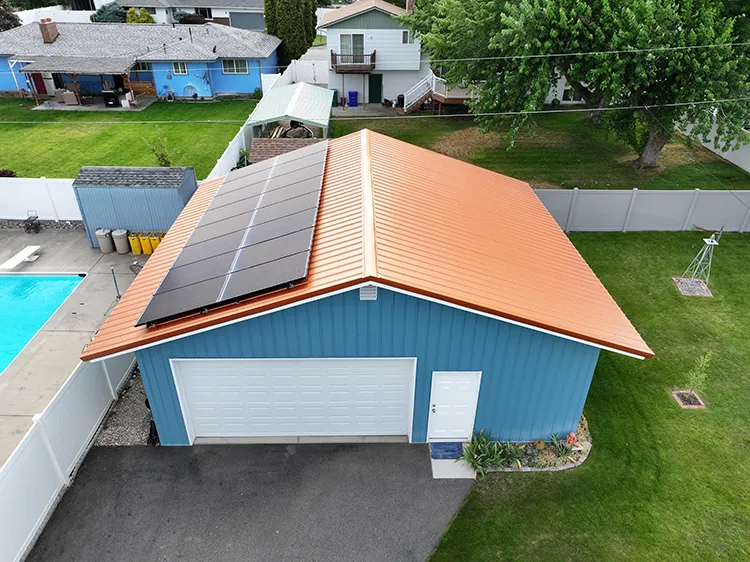
Once SB 1354 takes effect, here are the most common configurations SSA customers in Idaho are considering.
Detached Guest House or In-Law Suite
A separate structure with its own living space, bathroom, and kitchen or kitchenette. Ideal for multigenerational households, long-term rental income, or housing a caretaker. SB 1354’s size protection means you can build up to at least 1,000 square feet, or up to 75% of your primary home’s size if that figure is larger.
Detached Garage with Living Quarters
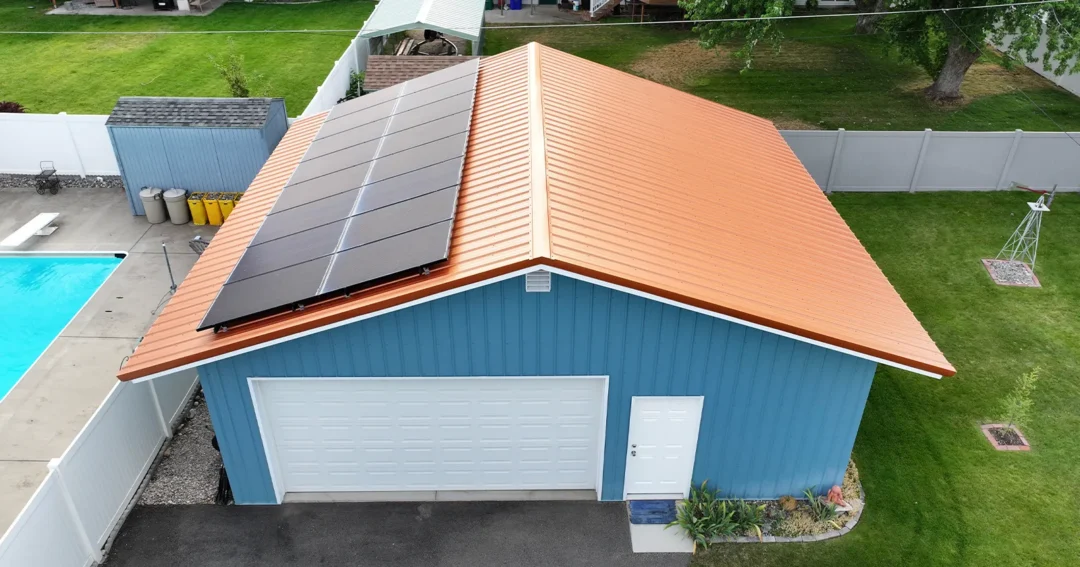
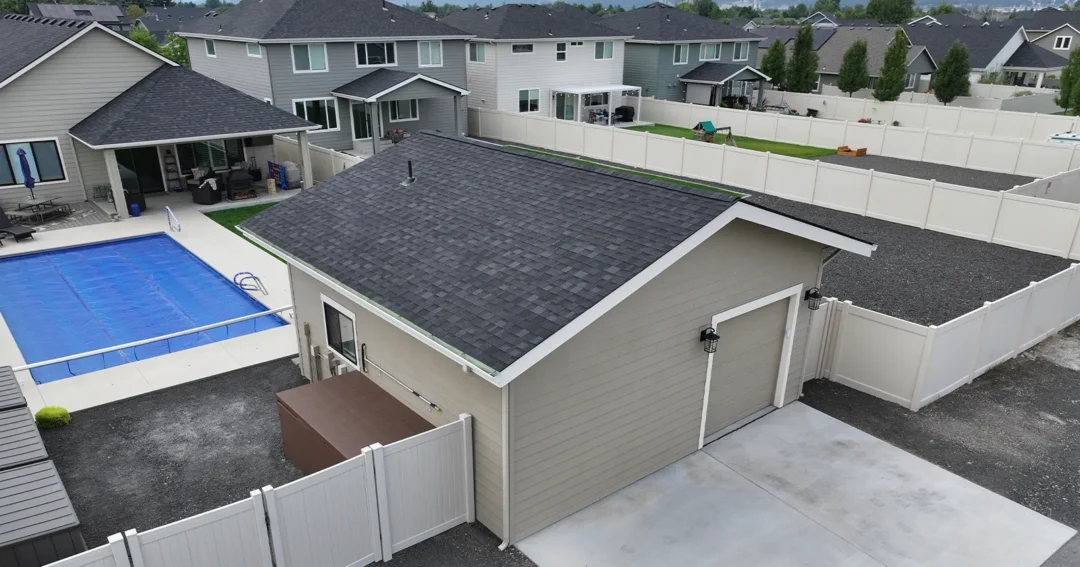
A combination building with a garage or shop on one side and finished living quarters on the other. This is one of the most popular configurations SSA builds because it puts the shop space and the guest or rental space under one roof. The garage portion is in addition to the ADU living space.
Shop or Barn with Living Quarters
A larger structure where storage or workspace is the primary focus, with a fully finished living area built in. This configuration is a natural fit for SSA customers with acreage who already think in terms of shop-plus-living arrangements.
Small Standalone Cottage
A compact detached dwelling designed purely as a separate living space. Popular for housing adult children, aging parents, or generating long-term rental income. Under SB 1354, the city cannot require it to be smaller than 1,000 square feet or 75% of your primary home’s footprint, whichever is the larger number.
Why Post-Frame Construction Works Well for ADUs
Post-frame buildings are what Steel Structures America specializes in, and they are an excellent construction method for detached ADUs in Idaho. Here is why.
- Faster build timelines than conventional stick-frame construction for comparable square footage
- Wide clear-span interiors that allow flexible floor plans without interior load-bearing walls
- Lower cost per square foot than most other construction methods
- Easy to combine living space with garage or shop space in a single building
- Can be fully finished to residential standards, including insulation, HVAC, plumbing, and electrical
A post-frame ADU is not a barn being repurposed. When properly designed and engineered, it is a fully code-compliant residential structure meeting International Residential Code requirements. That means standard permit requirements apply: engineer-stamped plans, inspections, and the same mechanical, electrical, and plumbing standards as any residential construction.
We are also a Perma-Column partner. For ADU structures expected to serve as permanent residential buildings for 50 or more years, Perma-Column precast concrete foundations eliminate the wood-to-soil contact that causes post rot over time. Some Idaho jurisdictions specifically require or recommend concrete foundation systems for habitable post-frame structures, and Perma-Column satisfies that requirement.
Typical ADU Size Ranges We Build
To give you a sense of what is common for Idaho ADU projects:
- Small ADU (studio or 1-bedroom): 400 to 700 sq ft. Common footprints include 20×24 and 24×30. Note that Idaho’s minimum size protection may require larger depending on your primary home’s square footage.
- Medium ADU (1 to 2 bedroom): 700 to 1,000 sq ft. Common footprints include 24×36 and 30×40.
- Garage plus living combo: The living portion meets ADU minimums; the garage or shop is in addition. Common footprints are 30×50, 40×60, and 40×48.
- Larger ADU: 1,000 to 1,600 sq ft of living area. Idaho’s 75% rule may allow and even require a larger minimum on properties with large primary homes. Common footprints include 30×48 and 40×50.
Why Steel Structures America for Your Idaho ADU Project
Steel Structures America is based right here in Post Falls, Idaho. We have completed more than 15,000 projects for property owners across the Inland Northwest and Mountain West, including custom garages, shops, barns, pole barns, and combination living structures.
We know the ADU permitting landscape in north Idaho and across the state. We have helped customers in Coeur d’Alene, Post Falls, and surrounding communities navigate the building process from initial design through permit submission to finished construction. Our team understands what Idaho building departments expect from engineered residential post-frame structures.
As SB 1354 takes effect and cities begin updating their codes, we expect ADU projects to become an increasingly common request. If you are thinking about what is possible on your property and want to talk through your options, we are right down the road and would be glad to have that conversation.
| Ready to Explore Your Options? Call Steel Structures America at (800) 833-9997 or visit steelstructuresamerica.com to get started. Our team has completed over 15,000 projects and is ready to help you figure out what works for your property. |
Frequently Asked Questions
Does Idaho’s new ADU law apply to my property?
SB 1354 applies to properties inside city limits in Idaho cities with populations over 10,000. If you are inside Coeur d’Alene, Post Falls, Boise, Nampa, Meridian, or other qualifying cities, the law will apply to you once it takes effect on July 1, 2026. If your property is in unincorporated county land outside city limits, SB 1354 does not apply.
When exactly does SB 1354 take effect?
The law takes effect July 1, 2026. Cities have until February 1, 2027 to update their local codes to comply. During that window, check with your specific city’s planning department, as some cities may update their codes promptly while others wait until closer to the deadline.
How many ADUs can I build under Idaho’s new law?
SB 1354 protects one ADU per single-family residential lot. That ADU can be either an internal unit within your primary home or one detached structure in the rear yard. The law does not protect both as a simultaneous right. If you want a detached ADU, you choose that option and it must be located in the rear yard. If you want an internal unit, you choose that one.
How big can my ADU be under Idaho law?
Cities cannot limit your ADU to less than 1,000 square feet or 75% of your primary dwelling’s size, whichever of those two numbers is larger. So if your home is 2,400 square feet, a city cannot require your ADU to be smaller than 1,800 square feet (75% of 2,400). You can build smaller if you choose, but the city cannot mandate it.
Do I still need a permit?
Yes. SB 1354 gives you a right to build an ADU, but it does not eliminate the permitting process. The law specifically requires cities to approve qualifying ADU projects administratively, meaning they cannot subject you to a lengthy discretionary review process. But a standard building permit, engineer-stamped plans for a post-frame structure, and inspections are still required.
My property is outside city limits in rural Kootenai County. Does this law apply to me?
No. SB 1354 covers cities, not counties. For unincorporated properties in Kootenai County, Ada County, or any other Idaho county, your ADU rights depend on your county’s existing zoning rules. Contact your county planning and zoning office directly.
Can my HOA stop me from building an ADU under the new law?
It depends on when you bought your property and what your CC&Rs say. Under SB 1354’s HOA provisions, your HOA cannot add new anti-ADU restrictions or enforce ones added after you purchased. However, if your CC&Rs already prohibited ADUs when you bought the property, those restrictions can still be enforced. Review your specific documents and consult a real estate attorney if you are uncertain.
Does Idaho’s law cover historic properties?
Properties designated under Idaho Code Sections 67-4607 or 67-4614 as historic districts or historic properties are exempt from SB 1354’s requirements. If your home is on a state or local historic register, verify your specific situation with your city’s planning department.
What is the difference between an internal ADU and a detached ADU?
An internal ADU is located within the primary home or its attached or detached garage. Think of a basement apartment, a converted bonus room, or a garage conversion. A detached ADU is a completely separate freestanding structure on the same lot, and under SB 1354 it must be placed in the rear yard. Steel Structures America builds detached ADUs. Under SB 1354, you are protected in choosing one or the other, not both.
Can I rent out my ADU?
You can rent it as a long-term rental. SB 1354 explicitly prohibits cities from requiring you to live in the primary home or the ADU. Short-term rental restrictions are not explicitly addressed in SB 1354, so local city rules on short-term rentals still apply. Check your city’s ordinance if you are planning to list the ADU on Airbnb or a similar platform.