
Washington ADU Law Changes: What Eastern Washington and Spokane Homeowners Need to Know
Washington’s ADU law changes are opening up real options for homeowners across eastern Washington, including Spokane, Spokane Valley, the Tri-Cities, and surrounding communities. If you have heard that the rules around accessory dwelling units changed but are not sure exactly what that means for your property, you are in the right place. This guide breaks down what the new laws actually say, who they apply to, and what you can realistically do with your land.
At Steel Structures America, we have completed more than 15,000 building projects in the Pacific Northwest and Mountain West. We have been watching these ADU law changes closely because they directly affect what our customers in Washington can build. We will walk you through everything you need to know.
This article focuses on facts and clarity. If you’d like some perspective on why this is a golden opportunity, read this opinion piece.
| Important Note: This article explains Washington state law in plain language. It is not legal advice. For guidance specific to your property and situation, consult your local planning department and a qualified real estate attorney. |
What Is an ADU, and Why Does Any of This Matter?
An accessory dwelling unit, or ADU, is a second living space on a single-family residential lot. It can be attached to your home (like a converted basement or garage apartment) or detached (a separate structure in the backyard). You might have heard these called backyard cottages, granny flats, in-law suites, or guest houses.
For years, many Washington cities and counties had strict rules that made ADUs difficult or impossible to build. Some required the owner to live on-site. Others imposed high fees, excessive setback rules, or simply banned detached units altogether. Washington state passed two significant laws to change that, and the result is a meaningful expansion of what property owners across eastern Washington can now do.
The Two Laws You Need to Know About
House Bill 1337 (2023): The Urban ADU Mandate
HB 1337 was signed by Governor Jay Inslee on May 8, 2023, and took effect on July 23, 2023. It applies to cities and counties that plan under the state’s Growth Management Act, which includes all incorporated cities in Washington. If you live in Spokane, Spokane Valley, Kennewick, Richland, Pasco, or any other incorporated city in eastern Washington, this law applies to you.
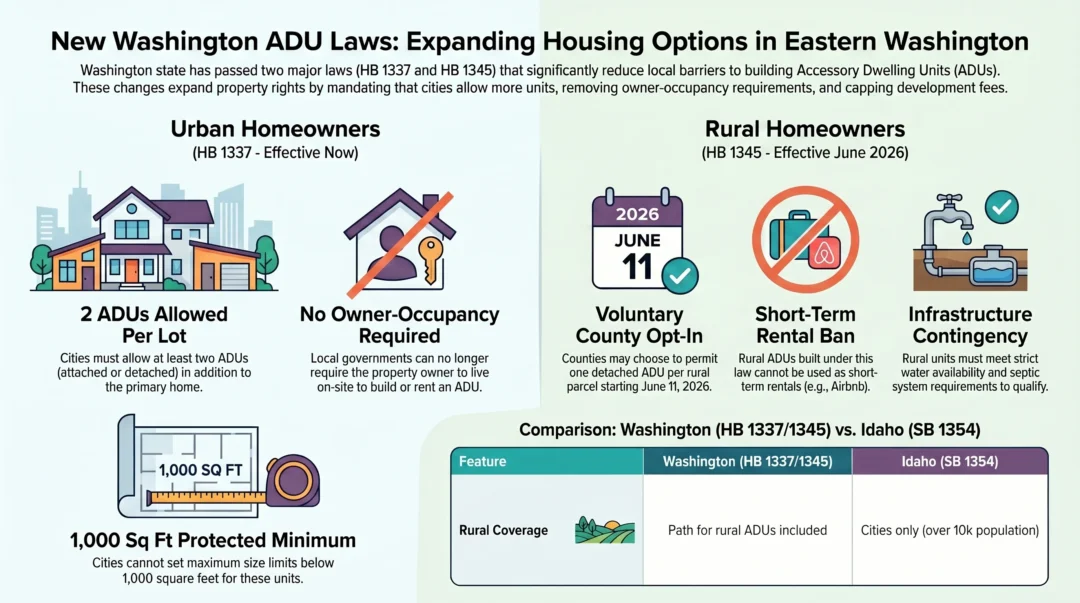
What it requires: Cities must allow a minimum of two ADUs per lot in addition to the main home. The two ADUs may be any combination of attached and detached, including conversions of existing structures like garages. Local governments cannot prohibit this.
Compliance deadline for eastern Washington cities: For most eastern Washington jurisdictions, including the City of Spokane, the compliance deadline was June 30, 2025. That deadline has passed. Cities that have not updated their local codes are operating under the state statute, which automatically supersedes conflicting local rules.
In plain terms: Spokane and similar eastern Washington cities must now permit ADUs. If your city still has an ordinance on the books that bans detached ADUs, that ordinance is legally void.
House Bill 1345 (2026): The New Rural ADU Law
HB 1345 was signed by Governor Bob Ferguson on March 27, 2026, and takes effect June 11, 2026. This one is significant for rural eastern Washington landowners who were not covered by HB 1337.
While HB 1337 applied only inside urban growth boundaries, HB 1345 allows counties planning under the Growth Management Act to permit detached ADUs on rural properties outside those boundaries. If you own acreage in eastern Washington outside of an incorporated city and your county fully plans under the GMA, this law may create a path for you to add a detached structure with living quarters once it takes effect.
Key detail: County participation under HB 1345 is voluntary. Counties are not required to allow rural ADUs, but the law authorizes fully planning GMA counties to do so if they choose. Check with your county’s planning department to find out where they stand.
What rural landowners should know: Under HB 1345, counties may allow one detached ADU per rural parcel. ADUs on rural parcels cannot be used as short-term rentals, water availability requirements must be met, and ADUs may not be built on lots with critical area designations, critical area buffers, or certain watershed protections.
| Eastern Washington Rural Note: Many of SSA’s customers in the Spokane region and Inland Northwest own acreage outside city limits. HB 1345 (effective June 11, 2026) will create a path for rural detached ADUs in Washington for the first time, subject to county opt-in. Contact your county planning department to find out if your county is planning to participate. |
What These Laws Actually Protect
Both laws set a legal floor, meaning local governments cannot go below these protections. Here is a summary of what they prohibit cities from doing.
What Cities Cannot Do Under HB 1337
- Require the property owner to live on-site (owner-occupancy rules are prohibited)
- Charge ADU impact fees greater than 50% of the fee on the primary home
- Set height limits below 24 feet for ADUs (unless the primary home itself is below 24 feet)
- Impose setback requirements, yard coverage limits, tree retention mandates, restrictions on entry door locations, aesthetic requirements, or design review requirements that are more restrictive for ADUs than for the primary home
- Require off-street parking for ADUs located within half a mile of a major transit stop; outside that distance, parking may still be required but is capped at one space for lots under 6,000 sq ft and two spaces for larger lots
- Block the independent sale of an ADU as a condominium unit
- Require public street improvements as a condition of ADU permit approval
ADU Size Under HB 1337
Cities cannot require ADUs to be smaller than 1,000 square feet. The law sets a floor, not a ceiling. An ADU cannot be larger than the primary dwelling, but within that range, cities cannot mandate maximums below 1,000 square feet.
What Cities Can Still Do
The law does not eliminate all local authority. Cities can still:
- Restrict ADUs from being used as short-term rentals (Airbnb, VRBO, etc.)
- Apply standard health, safety, and building code requirements
- Decline ADU permits for properties not connected to public sewer
- Apply regulations in critical areas such as wetlands and steep slopes
| Private Septic Note: If your property is on a private septic system rather than public sewer, the HB 1337 mandate does not automatically apply. Confirm your sewer connection status before assuming you are covered by the state law. |
What This Means for Spokane Homeowners
Spokane is a Growth Management Act city inside an Urban Growth Area, so HB 1337 applies fully. Spokane’s compliance deadline was June 30, 2025. The city should now allow two ADUs per lot as a matter of right.
Spokane has also offered building permit fee waivers for ADU projects in the past. Before you plan your budget, confirm the current fee schedule directly with the City of Spokane Development Services Center at spokaneplan.com, since these programs can change.
For homeowners in unincorporated Spokane County outside city limits, the question is whether Spokane County opts in under HB 1345. Contact Spokane County Planning and Building at spokanecounty.org to find out the current status.
What This Means for Tri-Cities Homeowners
Kennewick, Richland, and Pasco are all incorporated cities in Washington, which means HB 1337 applies to all three. The compliance deadline for each city falls six months after its next periodic comprehensive plan update. For most eastern Washington cities the deadline has now passed, meaning state law is in effect. Homeowners should confirm the current status directly with their city’s planning department, as compliance timelines can vary by jurisdiction. The protected rights are the same as in Spokane: two ADUs per lot as a matter of right, no owner-occupancy requirement, and impact fees capped at 50% of primary home fees.
For rural Benton County and Franklin County landowners outside city limits, the path depends on whether those counties opt in under HB 1345. Contact your county planning department directly for the latest.
How These Laws Interact with HOA Rules
New homeowners’ associations formed after July 23, 2023, cannot adopt rules that restrict ADU construction on any lot. That protection is written into HB 1337.
If your HOA was formed before that date, existing covenants may still be enforceable. Before you plan a project, review your HOA’s CC&Rs carefully or consult a real estate attorney. State law removed the most burdensome local government barriers, but pre-existing private covenants operate in a different legal space.
Washington vs. Idaho: A Quick Comparison for Inland Northwest Homeowners
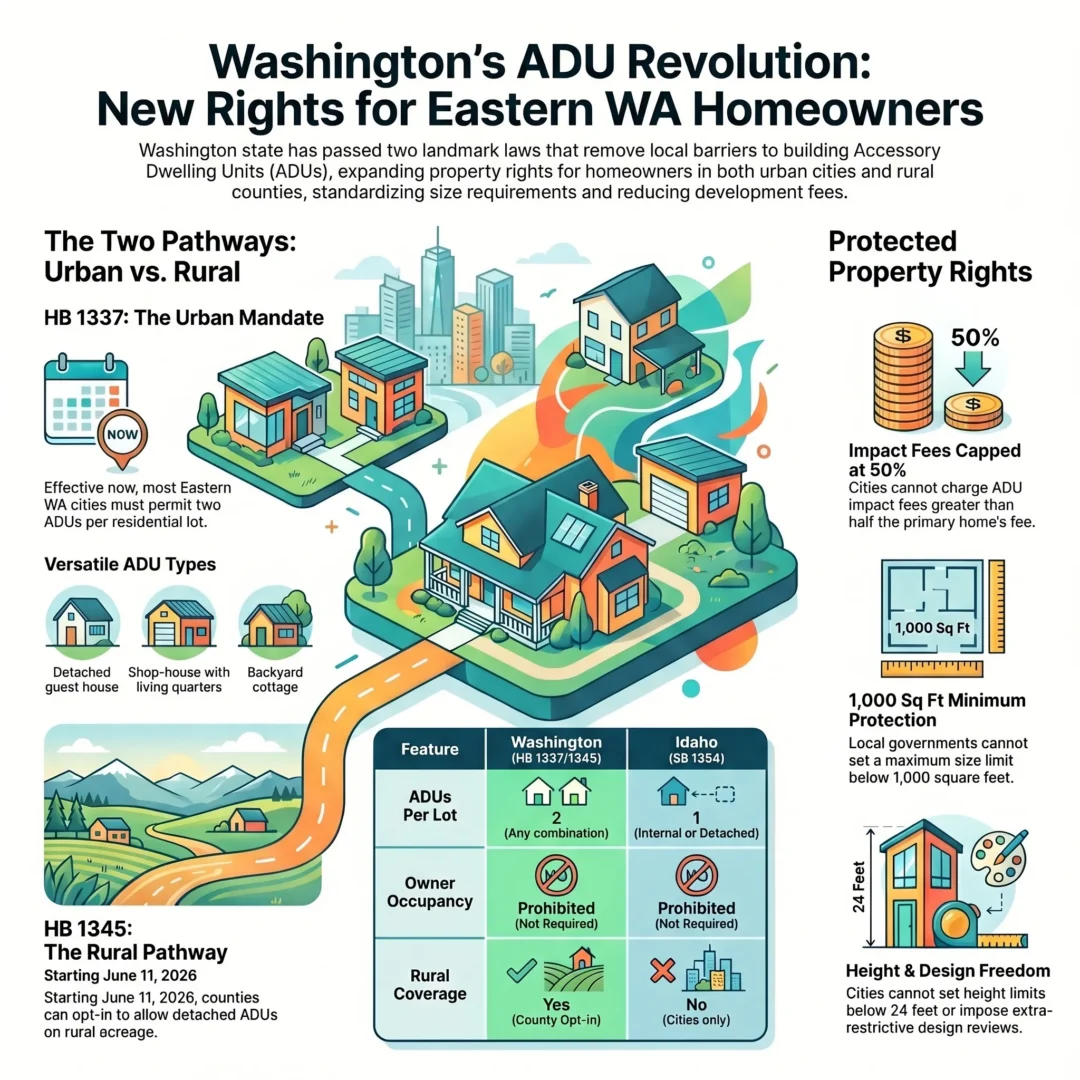
Many homeowners in the Spokane area have properties on both sides of the state line, or are weighing options in both states. Here is how the two states compare.
| Factor | Washington (HB 1337 + HB 1345) | Idaho (SB 1354) |
| Key new law | HB 1345 (rural ADUs, effective June 11, 2026); HB 1337 was signed May 8, 2023 | SB 1354 signed March 31, 2026 |
| Effective date | HB 1337: July 23, 2023; HB 1345: June 11, 2026 | July 1, 2026 |
| City compliance deadline | Most eastern WA cities (incl. Spokane): June 30, 2025 | February 1, 2027 |
| ADUs per lot (urban/city) | 2 ADUs per lot in any combination of attached and detached | 1 ADU per lot (either internal OR detached, not both) |
| ADUs per lot (rural) | 1 detached per rural parcel via HB 1345 (county opt-in) | SB 1354 is cities-only; rural areas not covered |
| Population threshold | None; all GMA cities in UGAs covered | Cities with more than 10,000 residents only |
| Owner occupancy required? | No. Explicitly prohibited. | No. Explicitly prohibited. |
| Minimum size protected | 1,000 sq ft minimum | 1,000 sq ft or 75% of primary dwelling, whichever is larger |
| Height minimum | 24 ft (or match principal unit) | Cannot be lower than height of existing primary dwelling |
| Impact fees | Capped at 50% of principal unit fees | Cannot exceed fees on other single-family dwellings |
| Private septic properties | NOT covered. Must be on public sewer. | Health/water/sewer standards preserved (Section 67-6541(7)) |
The bottom line: Washington’s law is more expansive. It protects two ADUs per lot in any combination, applies to all incorporated cities regardless of size, and will add a rural pathway through HB 1345 beginning June 11, 2026. Idaho’s new SB 1354 (effective July 1, 2026) covers cities with populations over 10,000 and protects one ADU per lot.
What Can You Build? Common ADU Types for Eastern Washington
The laws create the legal right. The next question is what makes sense for your property. Here are the most common ADU configurations we see in eastern Washington.
Detached Guest House or In-Law Suite
A separate structure in the backyard with its own living space, bathroom, and kitchen or kitchenette. Ideal for multigenerational families, rental income, or a caretaker on the property. These typically run 400 to 1,000 square feet depending on your needs and budget.
Detached Garage with Living Quarters
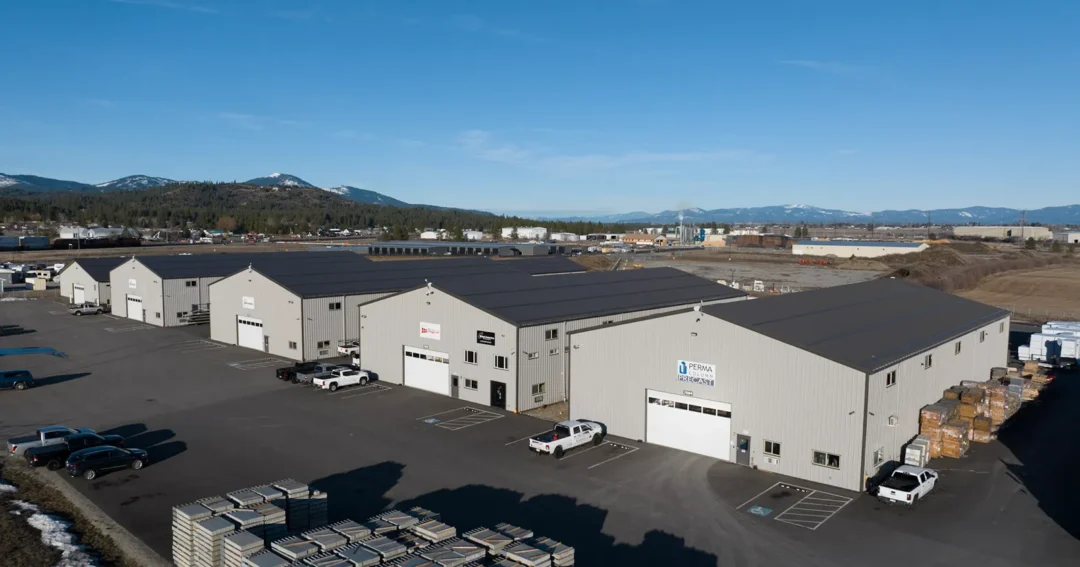
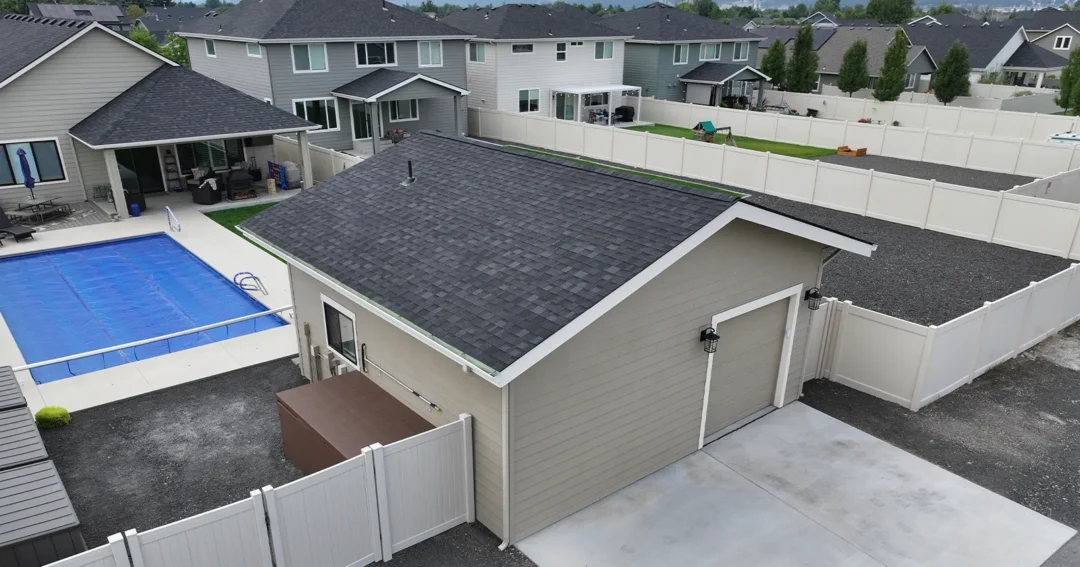
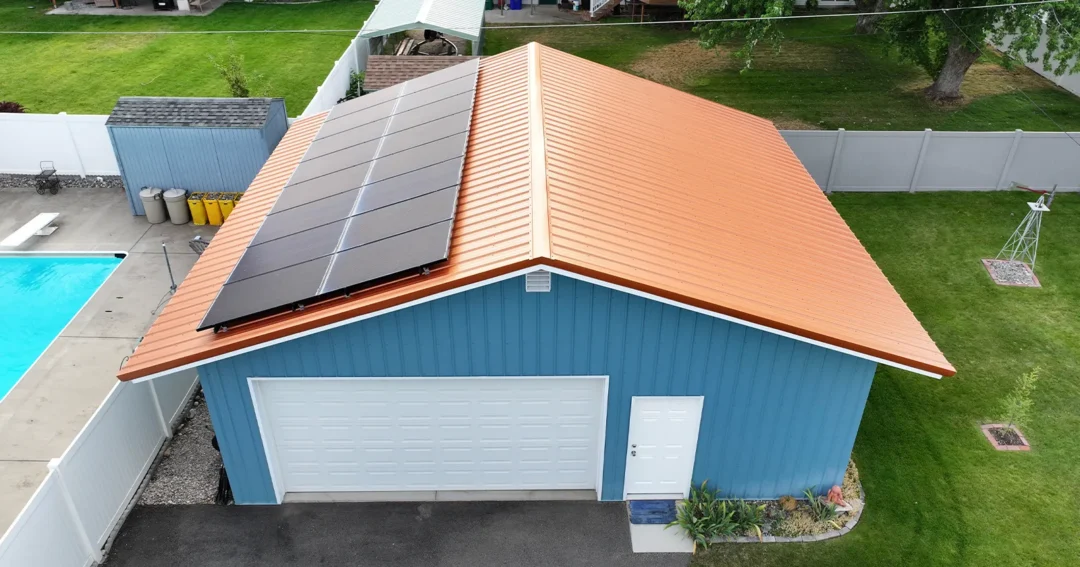
A building that combines garage or shop space on one side with finished living quarters on the other. This is one of the most popular configurations we build because it serves multiple purposes. The garage handles equipment and vehicles while the living side functions as a separate dwelling.
Shop or Barn with Living Space
A larger structure where the primary purpose is storage or workshop space, with living quarters built in. This appeals to customers who want a shop for their equipment, tools, or recreational vehicles alongside a place for family or guests to stay.
Small Standalone Cottage
A compact detached dwelling of 600 to 900 square feet designed purely as a separate living space. Popular for rental income or housing an adult child or aging parent while maintaining privacy for both households.
Why Post-Frame Construction Is a Great Fit for ADUs
Post-frame buildings, which are what Steel Structures America specializes in, are an excellent construction method for detached ADUs. Here is why.
- Faster build timelines than conventional stick-frame construction for comparable square footage
- Wide clear-span interiors that allow flexible floor plans without interior load-bearing walls
- Lower cost per square foot than most other construction methods
- Easy to combine living space with garage or shop space in a single building
- Can be fully finished to residential standards, including insulation, HVAC, plumbing, and electrical
A post-frame ADU can be engineered and permitted as a habitable dwelling meeting International Residential Code requirements. It is not a barn being repurposed. When properly designed and built, it is a fully code-compliant residential structure.
We are also a Perma-Column partner. For ADU projects that are permanent residential structures expected to last 50 or more years, Perma-Column precast concrete foundations eliminate the wood-to-soil contact that causes post rot over time. Some jurisdictions specifically recommend or require concrete foundation systems for habitable post-frame structures. Perma-Column satisfies that requirement.
Typical ADU Size Ranges We Build
To give you a sense of what is common in this market:
- Small ADU (studio or 1-bedroom): 400 to 700 sq ft. Common footprints include 20×24 and 24×30.
- Medium ADU (1 to 2 bedroom): 700 to 1,000 sq ft. Common footprints include 24×36 and 30×40.
- Garage plus living combo: The living portion meets ADU minimums; the garage or shop is in addition. Common footprints are 30×50, 40×60, and 40×48.
- Larger ADU: 1,000 to 1,600 sq ft of living area. Common footprints include 30×48 and 40×50.
Why Steel Structures America for Your ADU Project
Steel Structures America has been building custom garages, shops, barns, and combination living structures across eastern Washington, northern Idaho, Oregon, Colorado, and Montana for years. We have completed more than 15,000 projects for property owners exactly like you.
We understand the permitting landscape in the Pacific Northwest and Mountain West. We have helped customers navigate the building process from initial design through permit submission to final construction. Our team knows what local building departments in Spokane and across eastern Washington expect from engineered residential post-frame structures.
If you are thinking about adding a detached ADU to your property and want to talk through what makes sense for your land and your budget, we would be glad to have that conversation. We serve customers across eastern Washington from our home base in Post Falls, Idaho, and we know the Inland Northwest region as well as anyone in this business.
| Ready to Explore Your Options? Call Steel Structures America at (800) 833-9997 or visit steelstructuresamerica.com to get started. Our team has completed over 15,000 projects and is ready to help you figure out what works for your property. |
Frequently Asked Questions
Does the new Washington ADU law apply to my property in Spokane?
If you are inside the City of Spokane or another incorporated city in eastern Washington, yes. HB 1337 applies to all cities planning under the Growth Management Act. The compliance deadline for Spokane has passed, which means the state protections are in effect.
What if I am outside city limits in Spokane County?
That depends on whether Spokane County opts in under HB 1345, which takes effect June 11, 2026. Contact Spokane County Planning and Building directly to find out the current status for unincorporated areas.
Do I need a permit to build a detached ADU?
Yes. The new laws make ADUs a right, but they do not eliminate the permitting process. You will still need a building permit. The laws prevent cities from using the permitting process to unreasonably block or delay ADU projects that meet standard requirements.
Can my HOA stop me from building an ADU?
For HOAs formed after July 23, 2023, Washington law prohibits adopting rules that restrict ADU construction. For older HOAs, existing CC&R provisions may still be enforceable. Review your HOA documents and consult a real estate attorney if you are uncertain.
My property is on a septic system. Am I covered?
Not automatically. HB 1337’s ADU mandate does not apply to properties not connected to public sewer. You may still be able to build an ADU, but it will depend on whether your septic system can support it and whether your local jurisdiction approves it. Check with your county health department and planning office.
Can I rent out my ADU?
You can rent it as a long-term rental. Neither Washington law requires you to live on the property. However, cities can still restrict ADUs from being used as short-term rentals like Airbnb or VRBO, so check your local ordinance before planning that use.
How big can my ADU be?
State law says cities cannot require your ADU to be smaller than 1,000 square feet. Your ADU also cannot be larger than the primary home. Within that range, your local jurisdiction sets specific rules, but those rules cannot be more restrictive than what the state law allows.
What is the difference between an attached and detached ADU?
An attached ADU shares a wall with the primary home, such as a basement apartment or in-law addition. A detached ADU is a separate freestanding structure on the same lot. Both types are protected under HB 1337. Steel Structures America builds detached ADUs.