
Poles for a Pole Barn: Types, Depth, and What Lasts
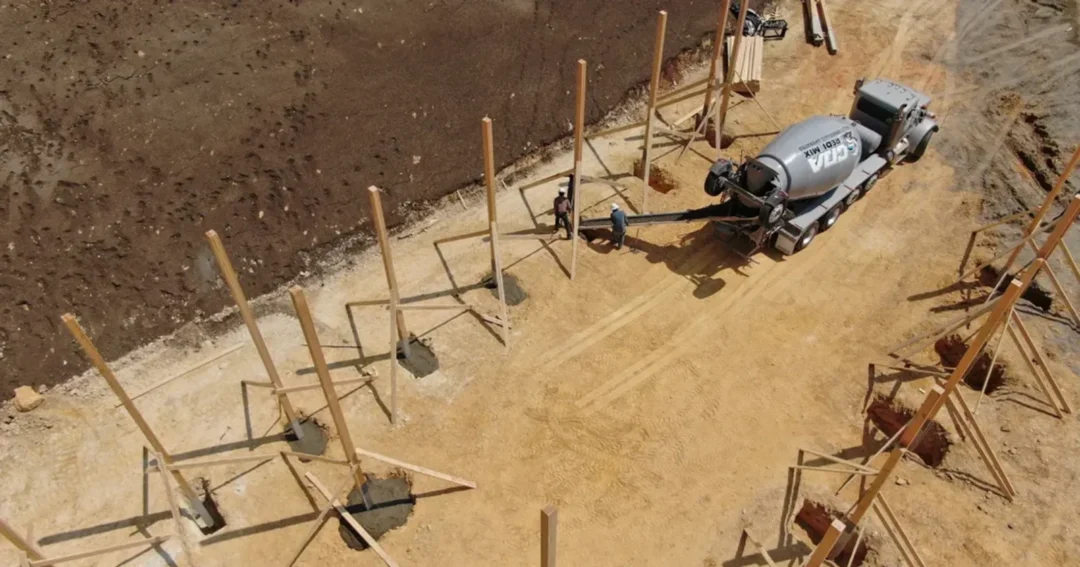
The poles are the building. In post-frame construction there’s no continuous perimeter foundation holding everything up, so the poles for a pole barn carry the roof load, resist wind uplift, and tie the whole structure to the ground. Choosing poles for pole barn construction comes down to three decisions: what the pole is made of, how it meets the ground, and how deep it goes.
None of those are cosmetic decisions. You’ll never see the poles once the building’s finished, and they’re the part most likely to determine whether it’s still standing straight in forty years. Here’s a plain-English breakdown of each one.
What the Poles Do
In a stick-built structure, load spreads across closely spaced studs sitting on a continuous foundation. Post-frame works differently. Large posts set at intervals around the perimeter carry the roof and the walls, which is why the inside can stay wide open with no interior load-bearing walls. Horizontal girts tie the posts together along the walls, purlins do the same across the roof, and engineered trusses span between the posts. Our guide to post-frame construction and how pole barns are built walks through the full sequence.
Because so much rides on so few structural members, the poles get engineered rather than picked off a shelf. Size, spacing, and embedment depth all come out of the drawings for your building, your snow load, and your soil.
What Poles for Pole Barn Construction Are Made Of
Laminated columns
Most modern post-frame buildings use laminated columns, which are several plies of dimensional lumber fastened together into one structural post. They’re more consistent than a single large timber, and the buried portion can carry a ground-contact treatment while the rest of the column doesn’t need it. This is the standard on most of what we build.
Solid sawn posts
A single treated timber. It’s straightforward and proven, and you’ll see it on smaller or simpler buildings. The tradeoff is that big solid timbers check and twist more as they dry out.
Round poles
The original, and where the name pole barn came from. Round treated poles still show up on older agricultural buildings. They’re uncommon on new engineered work now, mostly because square columns are easier to frame to.
Precast concrete columns
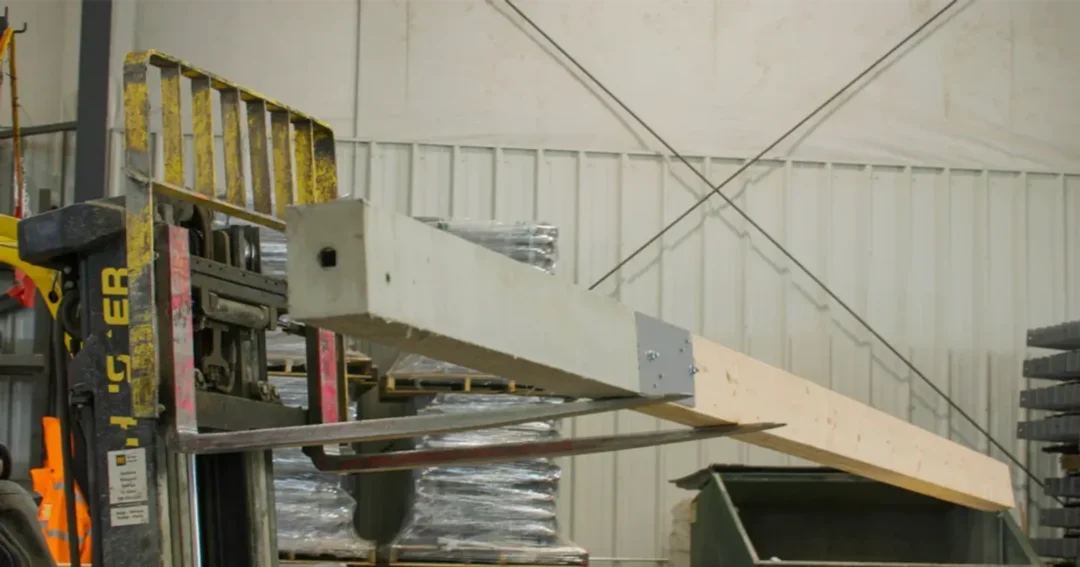
Perma-Column is a precast concrete column that goes into the ground in place of buried wood, with the wood post connecting above grade. Nothing organic sits in the soil. We’re a licensed Perma-Column installer, and you can read more about the system on the Perma-Column site.
How the Pole Meets the Ground
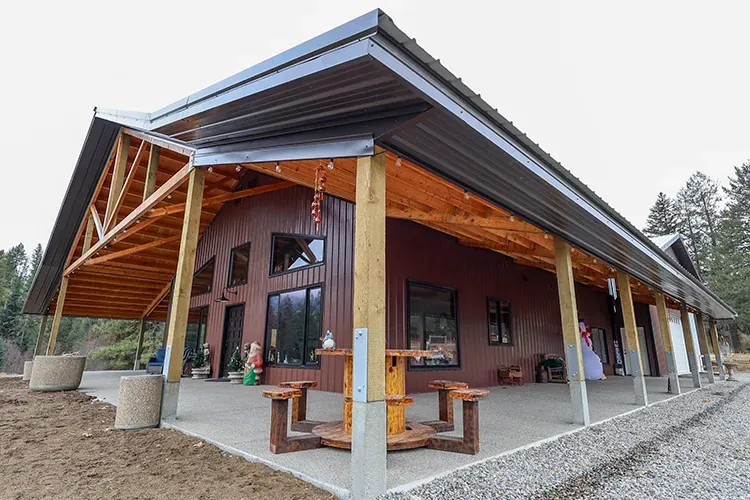
This is the decision that matters most for how long the building lasts, and there are three common answers.
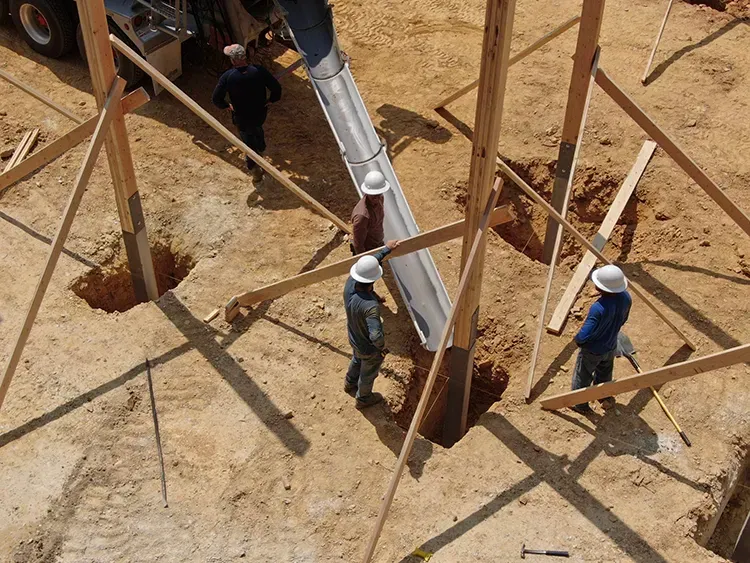
- In the ground. The traditional method and still the most common. A hole gets augered below the local frost line, the post is set plumb, and concrete is poured around the base to lock it in and shed water away from the wood. It’s the lowest upfront cost and it resists wind uplift very well.
- On concrete. A concrete footing or pad goes in first, and the post mounts above grade on an anchor bracket or notched base. The wood never touches soil. Uplift resistance has to come from the bracket and the connection instead of from burial.
- Precast concrete below grade. The Perma-Column approach, which keeps the structural behavior of a buried post while putting concrete in the soil instead of wood.
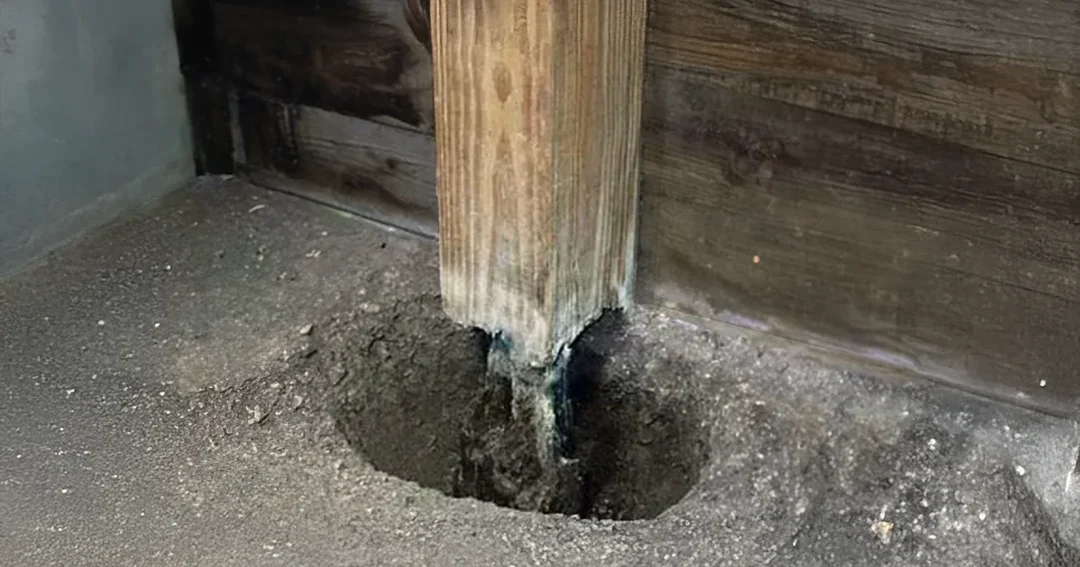
Even pressure-treated lumber rated for ground contact will break down eventually when it’s buried in damp soil, which is the whole argument for the second and third options. Our comparison of pole barn posts in ground versus on concrete covers the lifespan tradeoffs in detail, and pole barn foundations and footing options puts them next to the other foundation choices.
How Deep Do the Poles Go?
Typically 4 to 6 feet, depending on your local frost depth and the height of the building. The hole is augered, the post is set plumb, and the hole is backfilled with concrete or compacted gravel. In some applications the bottom of the hole is flared into a bell shape to create a larger bearing surface and add uplift resistance.
Treat those numbers as the normal range, not as your spec. Depth is an engineering answer, and it changes with frost depth, soil bearing capacity, building height, and wind exposure. If a builder gives you an embedment depth before they’ve looked at your site and your loads, they’re guessing.
Size and Spacing
Post-frame uses fewer, larger posts on wider spacing than stud framing, and that’s the source of most of the method’s cost advantage. Fewer pieces to set means less material and less labor, and it’s why the gap widens as buildings get bigger.
What determines the actual size and spacing on your building: the clear span, the eave height, the snow and wind loads, the soil, and where the door openings go. Wide sidewall openings in particular influence where posts can land. All of it gets specified in the engineered drawings, along with every connection detail from post to truss.
What This Means in the Northwest
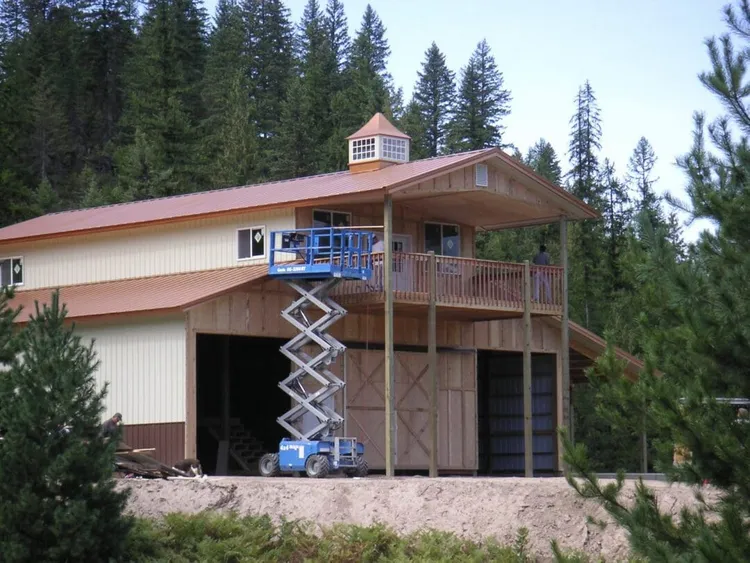
We’ve been building post-frame across the Northwest since 1996, and the poles are where regional conditions show up first. Frost depth isn’t the same in Post Falls as it is in Bend or Longmont. Wet winters and freeze-thaw cycles are hard on anything buried, and snow load drives how much the posts have to carry in the first place.
Drainage matters as much as the pole itself. Water that ponds against a post is what kills it, no matter what the post is made of, which is why site preparation, grading, and drainage deserve as much attention as the foundation spec. If you’re still sizing the building itself, our breakdown of a 40 x 60 metal building shows how footprint and eave height interact.
Common Questions
Do the poles have to be pressure treated?
Any pole in contact with soil does, and it needs a treatment rating meant for ground contact. On a laminated column, the treated portion is the part that’s buried. If the wood is kept above grade on a bracket or a precast column, the treatment requirement changes, which is one of the quieter advantages of those systems.
Can a rotted post be replaced?
Yes, though it’s real work. Posts can be repaired or replaced on an existing building, and it usually means temporarily supporting the structure while it’s done. It’s a lot more expensive than choosing a system that keeps wood out of the soil in the first place.
Are round poles worse than laminated columns?
Not inherently, but laminated columns are more consistent, easier to frame to, and easier to engineer around, which is why they’ve become the standard on new construction.
The Bottom Line
The poles are the least visible and most consequential part of a pole barn. Laminated columns are the modern default, in-ground setting is the economical standard, and keeping wood out of the soil with brackets or Perma-Column is the upgrade worth considering on any building you plan to keep for decades. Depth and spacing aren’t rules of thumb, they’re engineering.
If you’re planning a build anywhere in Idaho, Washington, Oregon, Montana, or Colorado and you want the foundation spec explained before you sign anything, give us a call at (800) 833-9997 or request a free quote. No sales pitch, just the information you need.