
Pole Barn Condensation: Causes, and What Your Contractor Can Do About It
Pole barn condensation is one of the most common complaints from owners of post-frame buildings, and it is also one of the most preventable problems in a well-planned build. If you have seen water dripping from a metal roof on a cold morning, or noticed frost on the inside of a metal wall, or found your equipment wet after a cool night, you have experienced the condensation problem firsthand.
The good news is that condensation in a pole barn is not an unsolvable mystery. It follows a specific and well-understood physical process, and a contractor who builds post-frame buildings correctly knows exactly what to specify to prevent it. This article explains how condensation happens, what it damages, and what your builder should be doing about it before a single panel goes up.
Why Condensation Happens in Pole Barns and Metal Buildings
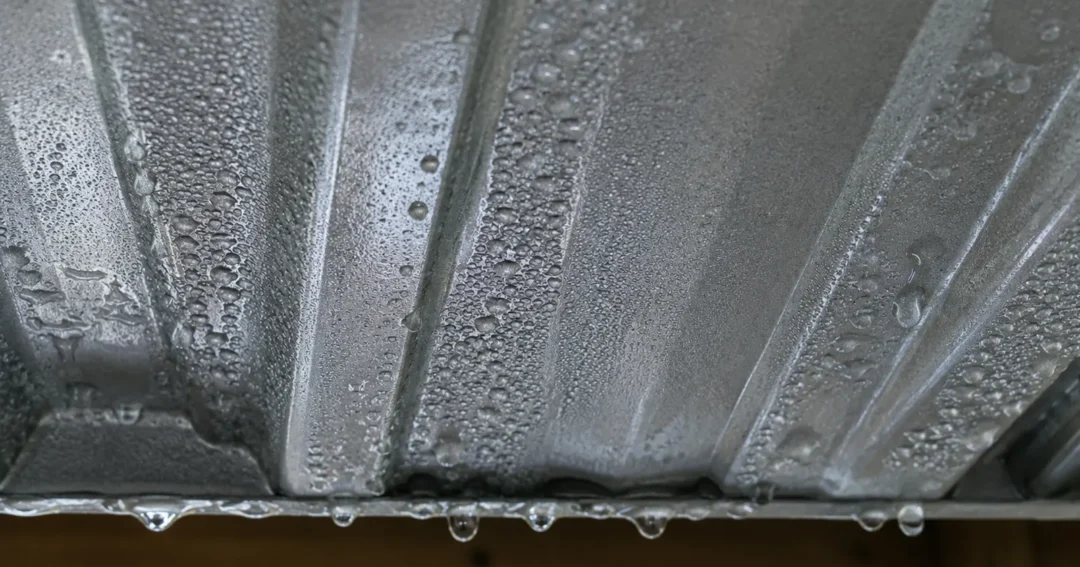
Condensation forms when warm, moisture-laden air contacts a surface that is cooler than the dew point of that air. In a metal building, the steel roof panels and wall panels are excellent conductors of temperature. On a cold night, those panels quickly drop to or below the outdoor temperature. Warm air inside the building, whether from animals, vehicles, people, or even the ground itself, carries moisture. When that warm air hits the cold metal surface, the moisture in it condenses into liquid water on the panel face.
This is the same process that fogs up your bathroom mirror after a hot shower. In a pole barn, it can happen across the entire roof and wall surface simultaneously, producing what looks like the building is sweating from the inside.
What Makes the Problem Worse
- High interior humidity from livestock, freshly cut hay, or wet equipment being stored inside
- Large temperature swings between day and night, which are common in Idaho, Montana, Colorado, and the high desert areas of Oregon and Washington
- Poor or absent ventilation that allows humid air to accumulate inside the building
- No insulation on roof panels, which means the steel surface temperature tracks closely with the outdoor air temperature
- Missing or improperly installed vapor barriers that allow ground moisture to enter the building
What Condensation Does to Your Building and Equipment
Beyond the annoyance of a dripping roof, unchecked condensation causes real damage over time.
- Rust and corrosion on metal panels, fasteners, and structural framing. Steel that stays wet will eventually rust, even with protective coatings.
- Rust and corrosion on stored equipment, tools, vehicles, and machinery. If your shop is regularly producing condensation, everything you store inside is at risk.
- Mold and rot in any wood components, including framing, storage shelving, or workbenches.
- Damage to hay, grain, and feed stored in agricultural buildings. Wet hay is a fire risk as well as a spoilage risk.
- Degraded insulation performance. Fiberglass insulation that gets wet loses a significant portion of its thermal value and can trap moisture against the wall or roof panel indefinitely.
- Fastener failure over time. Screws and nails in continuously wet framing members lose holding capacity as the wood cycles through wet and dry conditions.
What a Quality Contractor Does to Prevent Condensation
Condensation control is not a single product or a single decision. A contractor who builds post-frame buildings well addresses the problem through a combination of strategies that work together. Here is what each one involves.
1. Condensation-Control Underlayment on the Roof
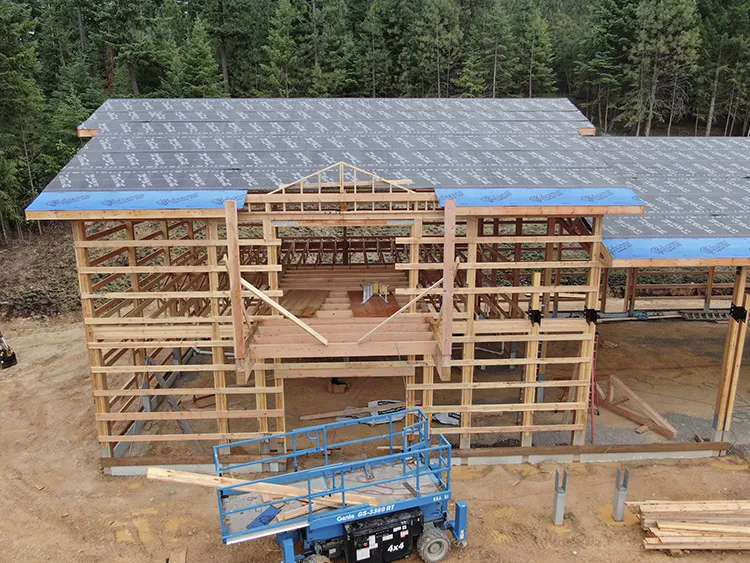
The most effective first line of defense in an uninsulated or lightly insulated building is a condensation-control underlayment applied directly to the underside of the roof panels. Products in this category use a woven or felt-like facing bonded to the panel that absorbs small amounts of moisture and holds it rather than allowing it to drip as liquid water. The absorbed moisture then evaporates slowly as conditions change.
This type of product is sometimes marketed under trade names. Your contractor may refer to it as a drip-stop underlayment, a condensation-control backing, or simply a foam-backed panel. Whatever it is called, the function is the same: it prevents the condensation that forms on the cold underside of the panel from dripping as liquid water onto your equipment and floor.
This approach works well for unheated storage buildings, agricultural buildings, and any structure where full insulation is not in the plan. It does not eliminate condensation as a physical process, but it manages the result effectively in most climates and use cases.
2. Full Insulation of the Building Envelope
The most complete solution to condensation is full insulation of the roof and wall panels. When the interior face of the insulation is warm and the cold steel panel is on the other side of the insulation, the warm humid interior air never contacts the cold surface. Condensation cannot form on a surface the air never reaches.
For any heated space, including a conditioned shop, a barndominium living area, or a building with livestock that generates heat, full insulation is the correct approach. The insulation system your contractor specifies needs to include an appropriate vapor barrier or vapor retarder on the warm side of the insulation to prevent moisture migration through the insulation toward the cold panel.
Spray foam is a particularly effective insulation choice for condensation control in metal buildings because it creates both an insulating layer and an air barrier in a single application. It fills gaps and irregularities that other insulation types can miss, eliminating the pathways that allow warm humid air to reach the cold panel.
3. Proper Vapor Barrier Installation
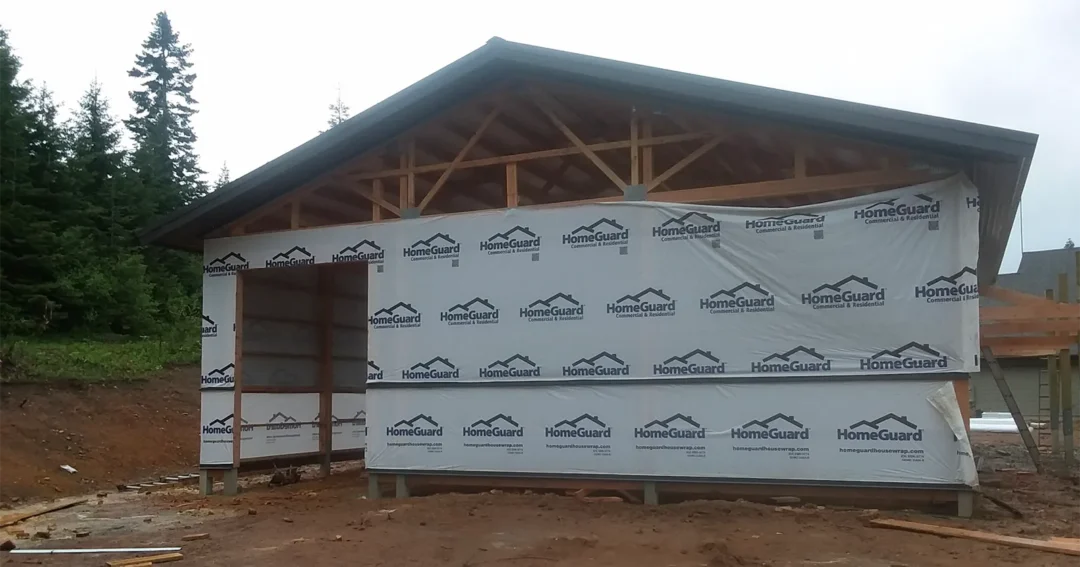
A vapor barrier slows or stops the movement of moisture-laden air through the building envelope. In a post-frame building, the vapor barrier is typically installed on the warm side of the insulation, between the insulation and the interior of the building. Its job is to prevent interior humidity from migrating through the insulation and reaching the cold exterior panels.
The vapor barrier must be installed continuously and carefully. Tears, gaps at seams, penetrations for electrical or plumbing that are not sealed, and incomplete coverage at wall-to-roof transitions all create paths for moisture to move through. A contractor who rushes the vapor barrier installation or treats it as an optional detail will produce a building that sweats in cold weather regardless of what else they did right.
In cold climates like northern Idaho, Montana, and the Colorado mountains, the vapor barrier becomes even more important because the temperature differential between inside and outside is greater and lasts longer through the year.
4. Ventilation
Ventilation is the other side of the condensation equation. Managing humidity inside the building reduces how much moisture the air carries, which reduces how aggressively condensation forms when that air contacts cold surfaces. A well-ventilated building exchanges interior humid air for drier outdoor air continuously, keeping interior humidity at a level where condensation is less likely to be a problem.
Your contractor should specify a ventilation system that provides adequate air exchange for your building’s use. For agricultural buildings with livestock, the ventilation requirement is higher than for a dry equipment storage building. For heated and insulated shops, the ventilation system works in combination with the insulation rather than as a substitute for it.
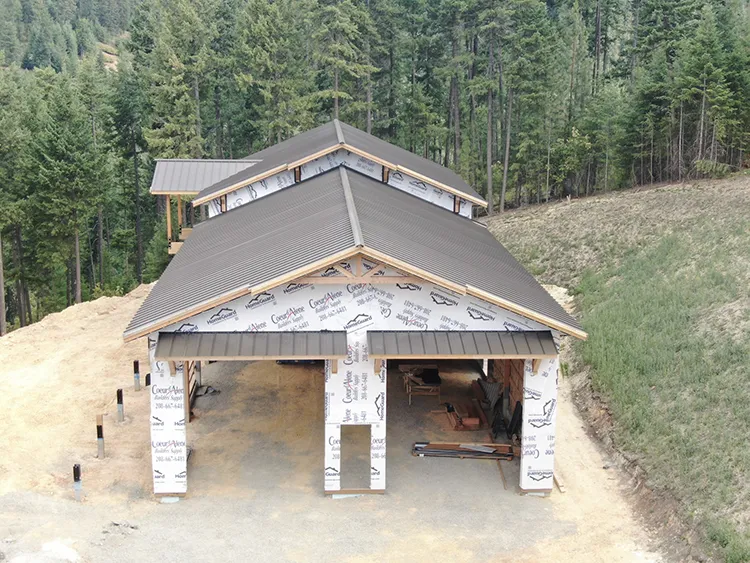
Ridge vents and eave vents are the standard passive ventilation system in post-frame buildings. They work by allowing warm air to exit at the ridge while cooler air enters at the eaves, creating a continuous convective air exchange without any mechanical equipment. Your contractor should be sizing that vent opening correctly for your building’s volume and use, not simply adding vents as an afterthought.
5. Ground Moisture Control
The ground inside and around your building is a significant source of moisture. Even in a building with a concrete floor, moisture can migrate through the slab if a vapor barrier was not installed beneath it during the pour. In buildings with gravel or dirt floors, ground moisture is a major ongoing source of interior humidity.
Ask your contractor whether a sub-slab vapor barrier is included in the concrete floor specification. In the inland Northwest and mountain West climates SSA serves, a 10- or 12-mil poly vapor barrier under the slab is a standard practice in quality builds. It costs very little added to the pour and makes a meaningful difference in long-term moisture management.
How to Evaluate Condensation Control When Comparing Contractors
Condensation control is one of those building details that is easy for a lower-cost contractor to skip because the consequence does not show up immediately. A building that lacks adequate condensation management may perform fine for the first year, then develop problems as seasonal temperature swings begin producing moisture damage that accumulates over time.
When you are comparing contractor quotes, ask the following questions specifically about condensation and moisture management.
- What condensation-control system do you use on the roof panels for an uninsulated building?
- For an insulated building, what insulation system do you specify, and where does the vapor barrier go?
- How do you seal the vapor barrier at penetrations, transitions, and edges?
- What ventilation does your standard build include, and how is it sized for my building’s intended use?
- Is a sub-slab vapor barrier included in the concrete floor spec?
- What is your experience building post-frame buildings in our climate zone, and what moisture management approaches do you use specifically for our winters?
A contractor who can answer these questions specifically and confidently is one who has thought through the problem. Vague answers or a dismissal of the question as not important are worth taking seriously.
We have a full guide on choosing the right contractors if you want to read more on this.
Condensation in a Building You Already Own
If you are dealing with a condensation problem in an existing pole barn or metal building, the solutions depend on what was built in originally and what your budget allows.
- For uninsulated buildings with chronic dripping from the roof, adding a condensation-control underlayment is not possible after the panels are on. The most practical retrofit is to add insulation below the roof panels, typically using batts hung below the purlins or spray foam applied to the underside of the panel from the interior.
- Adding ventilation is usually possible in an existing building. A ridge vent can often be cut in, and eave vents can be added if the soffit detail allows it. This alone will not solve severe condensation but will help manage interior humidity.
- Managing interior humidity sources reduces the severity of the problem. Removing wet materials, improving drainage around the building to reduce ground moisture, and using a dehumidifier in small heated spaces all help.
- A spray foam application on the interior of the roof and walls is the most complete retrofit solution for a building with chronic condensation problems. It is not cheap, but it addresses the root cause rather than managing symptoms.
For a building that has significant existing damage from long-term moisture, a contractor assessment is the right starting point before investing in any retrofit.
The Bottom Line on Pole Barn Condensation
Condensation in a pole barn is a building science problem, not a metal building problem. Wood-frame buildings develop moisture issues too. The difference is that metal panels transfer temperature very efficiently, which makes condensation more pronounced and more immediate in post-frame buildings when they are not properly detailed.
A contractor who understands this and addresses it systematically in the design phase will build you a building that performs well for decades. A contractor who skips condensation control to save a few hundred dollars per project will leave you with a building that sweats, rusts, and degrades from the inside.
Ask the question. It is one of the better differentiators between a quality build and a cheap one.
Building a New Pole Barn? Talk to SSA First.
Steel Structures America builds post-frame buildings across Idaho, Washington, Oregon, Colorado, and Montana. We specify condensation control, vapor barriers, insulation, and ventilation as part of every build, matched to your climate zone and your intended building use.
If you are planning a new pole barn, shop, or agricultural building and want to make sure it is built right from the ground up, give us a call at (866) 421-0412 or reach out through our website. We are glad to walk through the details with you.