
Pole Barn Square Footage Guide: How Much Space Do You Actually Need?
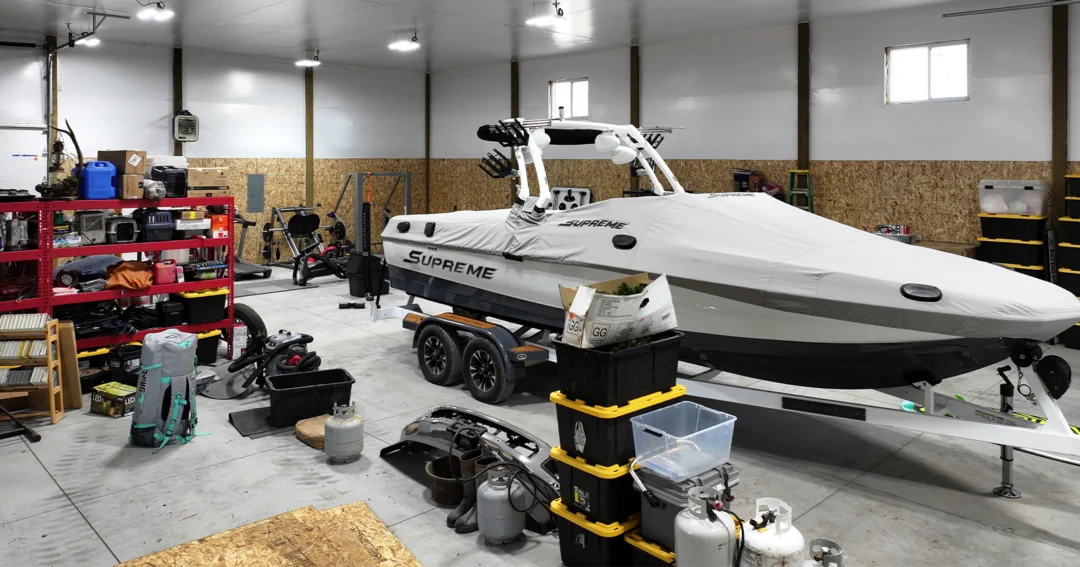
The question of how much space do I need in a pole barn seems simple until you start thinking about it seriously. A number like 2,400 square feet sounds like plenty, until you realize you are trying to fit an RV, a side-by-side, a full tool setup, and a workbench for projects, and suddenly it feels tight.
Pole barn square footage is only useful as a planning tool when you map it to what you are actually going to do in the building. The same 40×60 footprint that feels spacious to one buyer feels cramped to another, depending entirely on how they use it.
This guide breaks down space requirements by activity and use case, so you can build a pole barn that actually fits your life instead of one that is sized by guesswork.
Why Raw Square Footage Can Be Misleading
Square footage gives you the total floor area. What it does not tell you is how much of that space is genuinely usable for your specific needs.
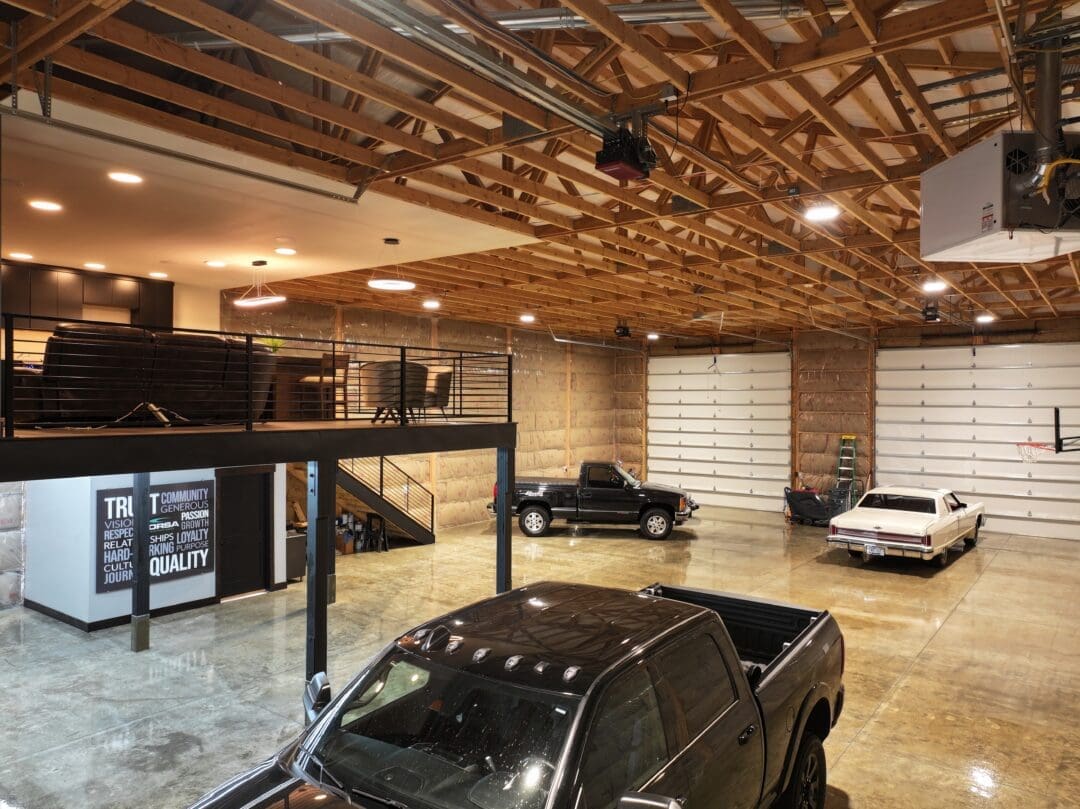
A 30×40 pole barn is 1,200 square feet on paper. But if you park two vehicles inside, you are already using 800 or more square feet just for parking footprints. Add in the fact that you need clearance around both vehicles to open doors, walk around, and move equipment in and out, and the remaining open space shrinks quickly. Most buyers are surprised by how fast vehicles, equipment, and basic storage eat through square footage that seemed generous in the planning phase.
Two additional factors that raw square footage does not capture: door placement and eave height. A building with the doors in the wrong place can make perfectly adequate square footage feel frustrating to use. And a building that is sized correctly for floor area but too short for your RV or tall equipment creates problems that no amount of floor space fixes.
Use this guide to think in real terms, not just numbers.
Pole Barn Square Footage by Use: The Full Breakdown
Garages and Vehicle Storage
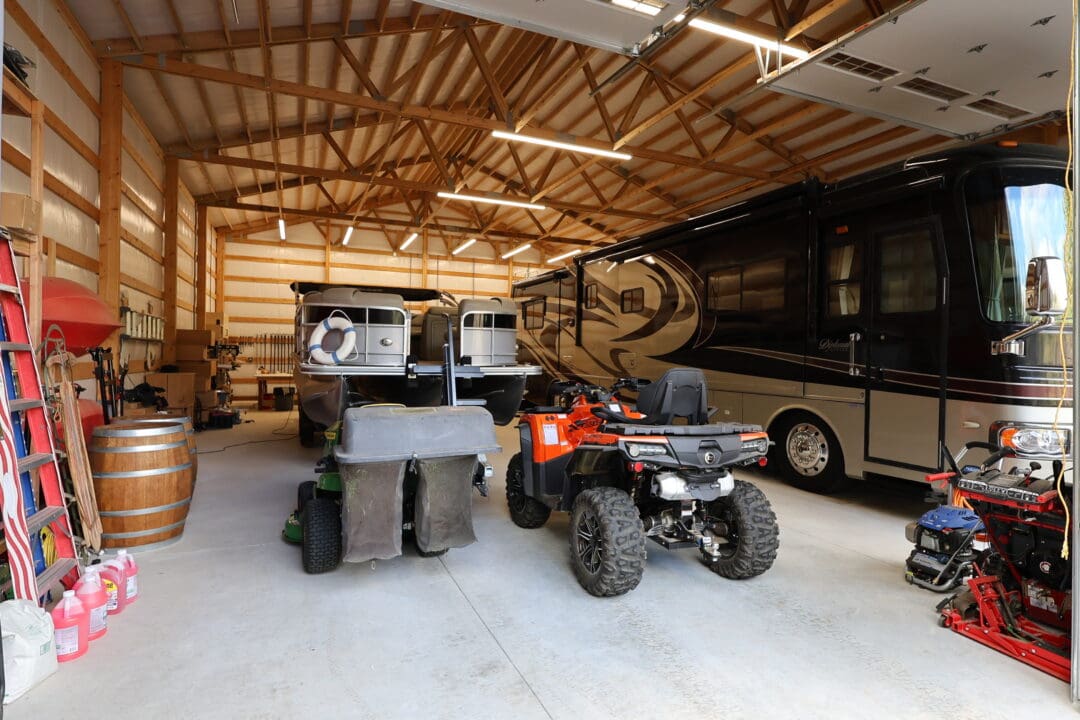
Vehicle storage is the most common reason people build pole barns, and it is the use case where buyers most often underestimate how much space they need.
Here is the honest reality of vehicle space requirements:
| Vehicle Type | Footprint (approx.) | Minimum Comfortable Bay Size |
| Compact car or sedan | ~65 sq ft | 10×20 per bay |
| Full-size pickup truck | ~110 sq ft | 12×24 per bay (14×26 preferred) |
| 3/4 or 1-ton dually pickup | ~130 sq ft | 14×26 per bay minimum |
| Full-size SUV or minivan | ~100 sq ft | 12×22 per bay |
| Crew cab truck with long bed | ~125 sq ft | 14×28 per bay |
The footprint of the vehicle itself is only the starting point. You need usable clearance on all sides: at least 3 to 4 feet between vehicles, 3 feet along the walls for doors to open fully, and enough depth from the front wall to the back wall that you can close the overhead door with the vehicle inside and still walk around the front.
A two-car setup with two full-size trucks requires a minimum of 30 feet of building width and 40 feet of depth to feel genuinely comfortable. Most buyers who are parking two trucks find that a 30×48 or 30×50 building serves them much better than a tighter 30×40.
Read more about pole barn garages in this article.
Workshop and Hobby Space
Workshop and hobby space requirements depend almost entirely on the type of work being done and how much equipment is involved.
For a basic hobby workshop with a workbench, some hand tools, and small power tools, 200 to 300 square feet of dedicated workspace is workable. That is roughly a 16×20 area within a larger building.
For a woodworking shop with a table saw, planer, jointer, bandsaw, and assembly space, 400 to 600 square feet of dedicated shop area is a more realistic minimum. Large woodworking equipment needs clearance on all sides for infeed and outfeed, which means the space around each tool matters as much as the tool’s own footprint.
For a fully equipped home mechanic shop with a lift, tool chests, a work area, and room to move a vehicle in and out, plan on at least 800 to 1,200 square feet of dedicated shop space. A two-post lift takes up the parking space of one vehicle plus significant surrounding clearance, and you need room to move around the vehicle when it is raised.
If you are combining vehicle storage with a workshop in the same building, do not try to share the space. Designate a separate zone for each function and plan the square footage accordingly. Most buyers who try to make parking bays and workshop space coexist in the same area end up frustrated by the result.
While making these considerations, it might be helpful to check out our guide on planning your dream shop.
Pole Barn Size for RV Storage
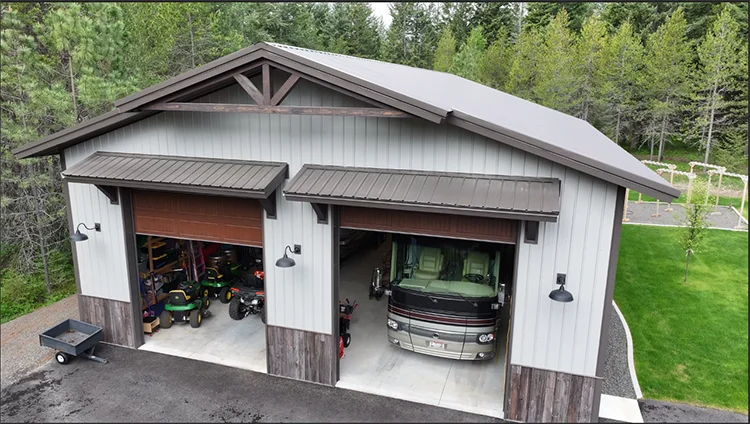
RV storage is one of the most size-specific use cases in pole barn planning because the vehicles themselves have very specific dimensional requirements that the building has to be designed around.
The most important measurement for a pole barn size for RV storage is not the floor footprint. It is the eave height. Most Class A motorhomes are 12 to 13 feet tall. A 14-foot eave is the minimum comfortable height for most Class A storage, and 16 feet gives you meaningful clearance plus room for rooftop accessories.
| RV Type | Typical Height | Typical Length | Minimum Bay Dimensions |
| Pop-up or small travel trailer | Under 10 ft | Under 25 ft | 12×28, 12 ft eave |
| Standard travel trailer | 11 to 12 ft | 24 to 35 ft | 14×40, 14 ft eave |
| Fifth-wheel trailer | 12 to 13 ft | 30 to 45 ft | 14×50, 14 ft eave |
| Class A motorhome | 12 to 13.5 ft | 30 to 45 ft | 16×50, 16 ft eave |
| Class C motorhome | 10 to 12 ft | 24 to 35 ft | 14×40, 14 ft eave |
For a dedicated single RV storage building, a 16×50 or 16×60 bay with a matching eave height is the most common recommendation for Class A and large fifth-wheel owners. If you want to store the tow vehicle alongside the RV in the same building, or add a side aisle for gear and maintenance access, a 30×60 or 40×60 footprint works much better than trying to squeeze everything into a narrow single-bay structure.
Also keep in mind that you need to park your slide-outs closed for storage and you need door clearance to get in and service the RV. A building that is perfectly sized for the vehicle itself with no extra room for any of those activities quickly becomes frustrating.
Pole Barn Size for Horses
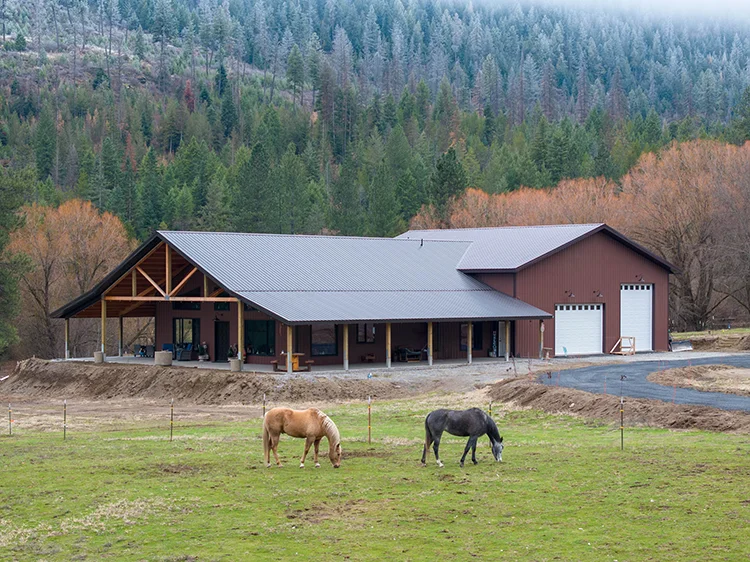
A pole barn size for horses depends on the number of horses, whether you want indoor stalls or open pasture access, and whether the building needs to include hay storage, a tack room, or a wash rack.
Individual stall sizes are the starting point for any horse barn calculation. A standard stall for most horse breeds is 12×12 feet, though 12×14 is preferred for larger breeds or mares with foals. Mini horses and ponies can use 10×10 stalls.
| Horses | Stall Sq Ft | Recommended Building Size |
| 2 horses, basic setup | 288 sq ft | 30×36 to 36×40 (includes aisle and tack room) |
| 4 horses | 576 sq ft | 36×48 to 40×60 |
| 6 horses | 864 sq ft | 40×60 to 40×80 |
| 8 horses | 1,152 sq ft | 40×80 to 50×80 |
| 10 or more horses | 1,440+ sq ft | 50×100 or larger, custom layout |
The stall square footage is only part of the equation. A functional horse barn also needs a center aisle wide enough to move a horse safely (10 to 12 feet minimum), a tack room (100 to 150 square feet for small barns, 200 or more for larger operations), feed storage, and ideally a wash rack with a drain. These elements add 400 to 800 or more square feet beyond what the stalls themselves require.
If you want hay storage inside the building, that adds significantly to the footprint or requires a gambrel design to use upper-level space for hay. An annual hay supply for four horses can easily require 400 to 600 square feet of storage space.
Pole Barn Size for Farm Use

A pole barn size for farm use is driven more by equipment dimensions than by headcount or any other metric. Farm buildings that feel perfectly sized in year one often become limiting by year three or four as the equipment inventory grows or the operation scales.
The most useful way to approach farm building square footage is to inventory your current equipment, identify the largest piece in each category, and add a meaningful growth buffer.
Equipment Footprints for Farm Planning
- Compact utility tractor (under 50 hp): 8×14 ft footprint, 10 to 12 ft height
- Row crop tractor (100 to 200 hp): 10×20 ft footprint, 12 to 14 ft height
- Large 4WD tractor (300+ hp): 12×24 ft or larger, 14 to 16 ft height
- Pull-type combine header (removed for storage): varies widely, up to 40 ft wide
- Combine body: 12×30 ft approximate, 12 to 15 ft tall
- Standard grain wagon: 10×20 ft
- Skid steer loader: 6×10 ft
- Round baler: 8×15 ft
- Sprayer: 10×20 ft body, boom folded
For a small to mid-size row crop operation with two tractors, a combine, a planter, and several smaller implements, a 60×100 to 80×120 building is a realistic starting point. Smaller grain and livestock operations focused on hay and smaller equipment can often work well in a 40×80 to 50×100 footprint.
The key numbers to watch for farm buildings are door width and eave height. A wide piece of equipment that does not fit through the door makes the rest of the building useless. Plan at least one large door for the biggest piece of equipment you own or expect to own, with 2 to 3 feet of clearance on each side and overhead.
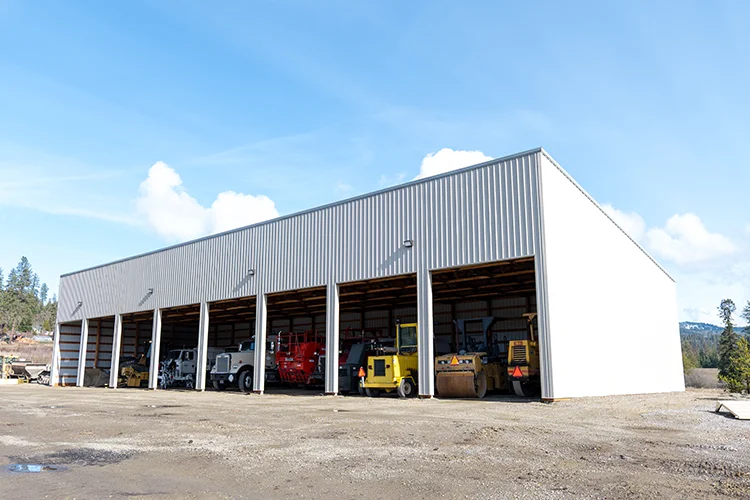
Contractor and Trade Shop Square Footage
For contractors building a dedicated shop for their business, the square footage calculation is similar to a farm equipment building but layered with business-specific needs like office space, customer meeting areas, parts storage, and multiple work bays.
A basic contractor shop for a single-person operation with one to two work vehicles and basic equipment storage can work in a 40×60 building. A growing contractor business with multiple vehicles, trailers, equipment, and crew members working simultaneously typically needs 40×80 to 50×100 or larger.
The biggest mistake contractors make when planning shop square footage is not accounting for the space that gets used by things that do not feel like space users when you are planning. Material staging areas, parts and supply storage, room to open trailer doors without moving other vehicles, a safe path for crew members to walk without crossing equipment movement paths, and enough room to park all vehicles and equipment at once without a daily puzzle are all things that eat into usable space.
For contractors, a useful rule of thumb is to add 30 to 40 percent to the square footage you think you need for operational space alone, then add any office, bathroom, or meeting room space on top of that.
Multi-Use Pole Barns: Planning for More Than One Activity
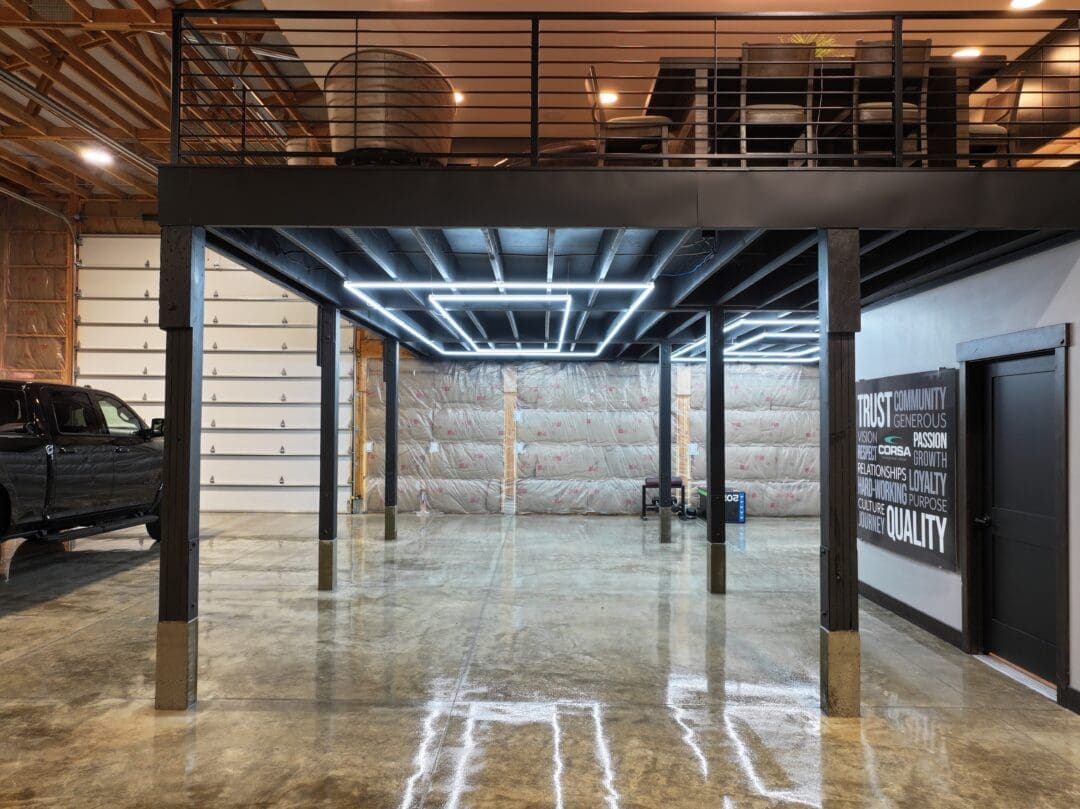
Many buyers are building pole barns that serve two or three distinct uses in the same building. The most common combinations are garage plus workshop, equipment storage plus farm office, and livestock plus hay storage. Planning the square footage for a multi-use building requires treating each zone as its own space requirement and then totaling them without expecting significant overlap.
The zones that people most often try to share are parking and workshop. This is the combination that almost always leads to frustration. When the shop gets busy, there is no room to pull a vehicle out. When the parking area fills up, there is no room to work on a project. Dedicated zones within the same building work much better than shared zones.
A well-planned multi-use pole barn defines the square footage for each function, lays out how those functions will be physically separated within the building, and then sizes the overall building to accommodate all of it without compression. The result costs more than a smaller building but almost always outperforms a cramped design over the life of the building.
A Simple Framework for Calculating Your Square Footage Need
Here is a straightforward way to calculate the pole barn square footage you actually need for your specific situation.
- Step 1: List every vehicle, piece of equipment, or large item you plan to store. Write down the actual dimensions of each, including height.
- Step 2: Add the footprints of all those items together. That is your base storage square footage.
- Step 3: Multiply that number by 1.5 to account for clearance, door swing, and movement paths. This is your minimum floor area for storage.
- Step 4: Add any dedicated work area square footage separately. Do not assume it comes out of the storage clearance.
- Step 5: Add any office, bathroom, or mechanical room space you plan to include.
- Step 6: Add 10 to 20 percent for future growth, items you will acquire, or uses you have not fully planned yet.
The result is a realistic square footage target you can use as the starting point for a conversation with your contractor about dimensions, layout, and budget.
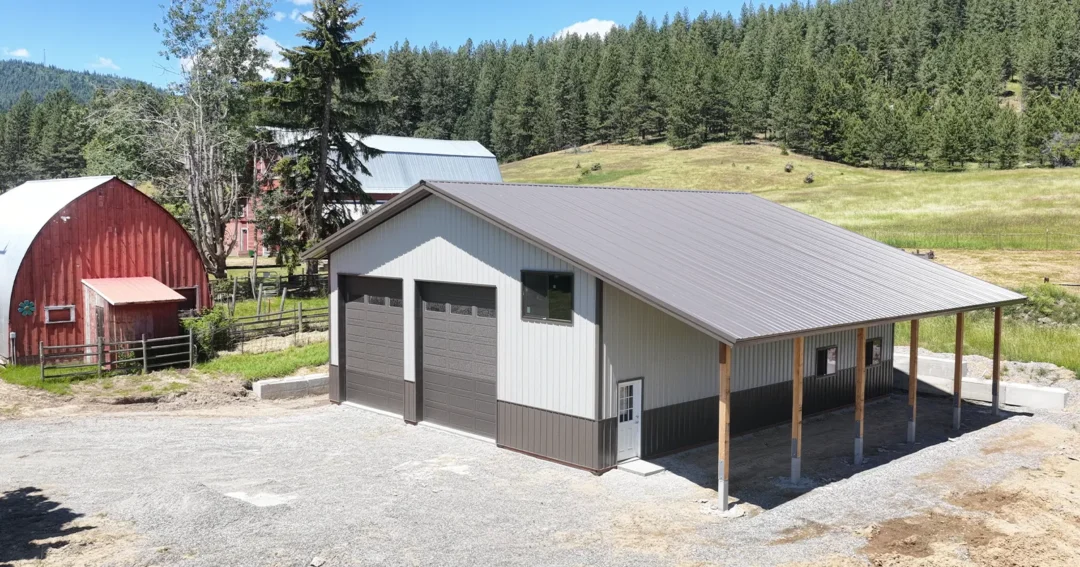
Don’t forget, you always have the option to increase useable space with the installation of a lean to, as shown in this article.

Ready to Plan Your Pole Barn Square Footage?
Steel Structures America works with buyers across Idaho, Washington, Oregon, Colorado, Montana, and surrounding states to design pole barns that fit their actual needs. Whether you are planning a two-car garage, a small barndominium, a horse barn, a farm equipment building, or a multi-use shop, we can help you work through the square footage and dimensions before anything gets built.
Call us at (866) 839-0506 or reach out online to get started.